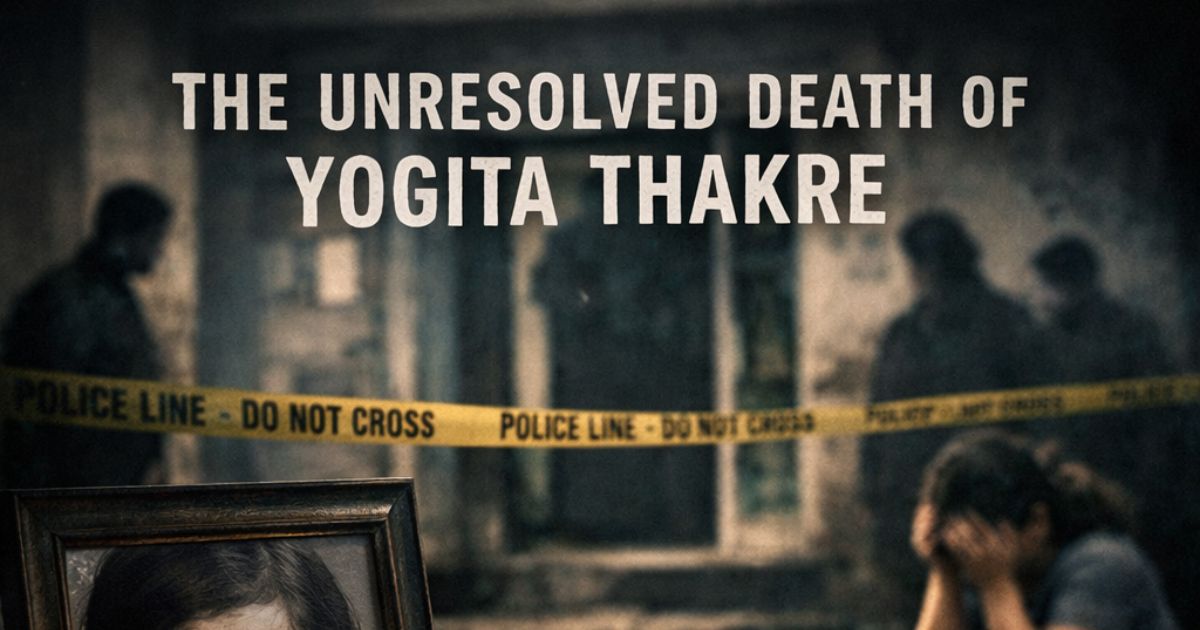
On May 19, 2009, seven-year-old Yogita Thakre was found dead inside a car parked in the compound of “Bhakti,” the Nagpur residence of Nitin Gadkari, then president of the Bharatiya Janata Party’s Maharashtra unit. Her mother, Vimal Thakre, a domestic worker in the neighbourhood, had left the child in the care of security guards at the house while she worked nearby. Hours later, the girl’s body was discovered in one of the vehicles. What followed was not a straightforward investigation but a series of official conclusions challenged by medical evidence, judicial rebukes, and persistent family allegations.
The case was registered at Kotwali Police Station as FIR No. 90/09. It began as an accidental death but was later converted to one under Sections 302 (murder) and 201 (destruction of evidence) IPC against unidentified persons. The post-mortem, conducted by Dr. P.G. Dixit of Government Medical College and Hospital, Nagpur, listed “smothering” as the cause of death—homicidal or accidental. The report documented nine fresh surface injuries: contusions on the gums and lips (suggesting the mouth was forced shut), abrasions on the left forehead, behind the ear, and back of the neck (consistent with the head being pinned down), and bruises elsewhere on the body. Critically, it noted an abrasion inside the vagina, blood clots in the inner vagina, dried blood stains on the right thigh and inner sides of both thighs, small blood stains on the underwear, bleeding from the nose and mouth, and a reddish discharge from the rectum. Chemical analysis later found no semen or poison.
Initial police theory pointed to suffocation after the child accidentally locked herself inside the car. Gadkari’s employees maintained she had climbed into the vehicle (identified in court records as a Fiat Linea, MH 31 CS 2727, owned by Sudhir Dive of the Purti group where Gadkari was chairman; early reports had mistakenly referred to Gadkari’s Honda CRV). They claimed a faulty central locking system trapped her. Tests on the locking mechanism produced mixed results. The family immediately disputed this account. Vimal Thakre said her daughter never played with cars and had been under the guards’ watch. Ashok Thakre, the father, alleged sexual assault followed by murder.
Local police faced sharp criticism for inconsistencies—shifting vehicle identification, delayed inquest, and a press conference by the Commissioner of Police that disclosed the post-mortem report, which the Bombay High Court later called a breach of investigative secrecy. In March 2010, the Bombay High Court (Nagpur bench) directed the Maharashtra Criminal Investigation Department (CID) to take over, citing the parents’ apprehensions of bias and investigative lapses. The court explicitly ordered a thorough probe into whether the death was homicidal or accidental, without transferring it to the CBI at that stage.
The CID submitted its first closure report in late 2011, concluding accidental suffocation: the child had entered the car, the doors locked, and she died struggling against hard surfaces that explained the bruises. A second closure report followed, reiterating the same findings and noting no eyewitnesses reported anything suspicious and that medical opinions allowed for non-homicidal injuries.
Judicial Magistrate First Class Nilima Patil rejected both reports. In December 2011 and again on February 21, 2013, she observed that the CID had merely recorded statements without genuine further investigation as mandated by the High Court. The magistrate described handing the case back to police as a “waste of time” and converted Ashok Thakre’s protest petition into a private criminal complaint (miscellaneous criminal case). The family was directed to examine witnesses themselves.
Attempts to escalate the matter yielded no breakthrough. In May 2013, the Supreme Court dismissed a PIL seeking a CBI probe, ruling that the magistrate should evaluate the CID’s report. Later that year, the Bombay High Court rejected a petition by Yogita’s sister Kiran Thakre for CBI investigation, calling it “premature” while the lower court proceedings continued.
Nitin Gadkari was never named in the FIR, nor were any charges filed against him, his family, or staff. He publicly stated he was open to any inquiry. The car in question belonged to an associate, not Gadkari personally, though it was parked at his residence. No trial has occurred. As of the latest available public records into 2025–2026, the case remains technically alive only as the private complaint filed in 2013. There are no reports of convictions, acquittals, or formal closure.
The Thakre family has described threats and intimidation; activists supporting them have called the investigation a textbook case of institutional reluctance when power is involved. Forensic experts consulted by media at the time noted that while semen absence ruled out completed rape, the genital injuries and blood staining raised questions about possible sexual assault that the CID’s accidental-death theory did not fully address. The family continues to reject the suffocation-in-a-locked-car narrative, citing the child’s unfamiliarity with vehicles, the guards’ presence, and the nature of the injuries.
Seventeen years later, four basic questions posed by journalists and the family remain publicly unanswered in any final judicial finding: How did a seven-year-old enter a car unnoticed by guards and staff in a secured compound? Why were the specific head and genital injuries consistent with restraint rather than random thrashing? Why did two successive CID closure reports fail judicial scrutiny for inadequate investigation? And why has a private complaint filed by an ordinary family in 2013 produced no discernible progress through the courts?
The Yogita Thakre case illustrates a pattern of initial investigative shortcomings, judicial rebukes of official conclusions, and prolonged stasis when influential figures are peripherally connected. No fresh forensic review or trial has occurred since 2013. For the family, it remains a search for answers; for the system, an unresolved test of accountability.
Sources
The revised article draws from contemporary news reports, court proceedings, and investigative coverage of the Yogita Thakre case (FIR No. 90/09, Kotwali Police Station, Nagpur). Key sources include:
- Bombay High Court order (2010): Directed Maharashtra CID to take over the investigation into whether the death was homicidal or accidental. See Smt. Vimal Ashok Thakre & Anr. v. In-Charge, Police Station Officer, Nagpur & Ors. (available on Casemine). (casemine.com)
- Post-mortem and initial findings: Reported across multiple outlets, including details of smothering as cause of death, multiple bruises/contusions (gums, lips, forehead, neck), and genital injuries (abrasion inside vagina, blood clots, stains on thighs/underwear). No semen or poison detected. Contemporary coverage: NDTV (2009), The Hindu (2011). (ndtv.com)
- Police and CID closure reports: Initial accidental death theory (child locked in Fiat Linea MH 31 CS 2727 owned by associate Sudhir Dive); CID submitted closure reports concluding accidental suffocation. Indian Express (2011), Telegraph India (2012), Hindustan Times (2012). (indianexpress.com)
- Judicial Magistrate rejections: Judicial Magistrate First Class Nilima Patil rejected the first CID closure report (December 2011) and the second (February 21, 2013), citing inadequate investigation per High Court directions and converting the protest petition into a private criminal complaint. The Hindu (Feb 23, 2013), NDTV (Feb 21, 2013), Times of India (Dec 22, 2011). (thehindu.com)
- Higher court proceedings:
- Supreme Court dismissed PIL for CBI probe (May 2013): Times of India, Firstpost, Business Standard. (timesofindia)
- Bombay High Court rejected sister Kiran Thakre’s petition for CBI inquiry as premature (December 2013): The Hindu. (thehindu.com)
- Family and staff accounts: Vimal Thakre’s statements on leaving the child with guards, child’s unfamiliarity with cars, and allegations of assault. The Hindu (2011), Rediff (2012), NDTV (2009). thehindu.com)
- Vehicle and Gadkari context: Car parked at “Bhakti” residence; not personally owned by Gadkari but linked to associate. Gadkari not named in FIR; publicly open to inquiry. India Today (2011), Rediff (2012).
- Later references and status: No reported trial, conviction, or formal closure beyond the 2013 private complaint. Recent mentions (2025–2026) note the case remains unresolved in public discourse. Medium/Likhai (2026 retrospective), various social media summaries consistent with 2009–2013 facts.
All details on injuries, court observations, and procedural history are corroborated across multiple independent news organizations from 2009–2013. No final judicial verdict on guilt or innocence has been reported. For primary documents, refer to Bombay High Court judgments and Nagpur court records from the relevant years.