Marital rape laws are a hot topic in 2026. People search for “marital rape laws by country,” “is marital rape illegal,” and “global marital rape laws” because this issue affects millions of women and families everywhere. In simple English, marital rape means any forced sex inside a marriage without the wife’s clear consent. It is not okay just because two people are married.
Today, about 150 countries treat marital rape as a crime. But in many places, the law still has gaps or does not protect wives fully. Some countries say “no” to marital rape clearly. Others stay silent or say marriage means automatic consent. This guide explains everything in easy words: the history, current rules by region, key country examples, recent changes, and what it all means for real life.
If you want to know if marital rape is legal in your country or how laws differ worldwide, keep reading. This complete overview uses the latest 2026 information from global reports, UN data, and country laws. We break it down step by step so anyone can understand.
Table of Contents
What Is Marital Rape and Why Does Consent Matter?
Marital rape happens when a husband forces his wife to have sex against her will. It can include physical force, threats, or pressure when she clearly says no. Consent is the key word here. Consent means both people freely agree and can change their mind at any time even after years of marriage.
In simple terms: Marriage is a partnership for love, home, and kids. It does not give one person ownership of the other’s body. A wife is not a “duty” machine. She has the right to say no, just like anyone else.
Why does this matter? Forced sex hurts the body and mind. Victims often feel shame, fear, depression, and health problems. Many stay silent because society says “it’s private” or “wives should obey.” Without strong laws, police and courts treat it as a “family issue” instead of a serious crime. Global studies show marital rape is one of the most common but least reported forms of violence against women.
Consent must be ongoing. It is not a one-time “yes” from the wedding day. In 2026, modern laws in many countries now say this clearly. But old ideas from history still block change in some places.
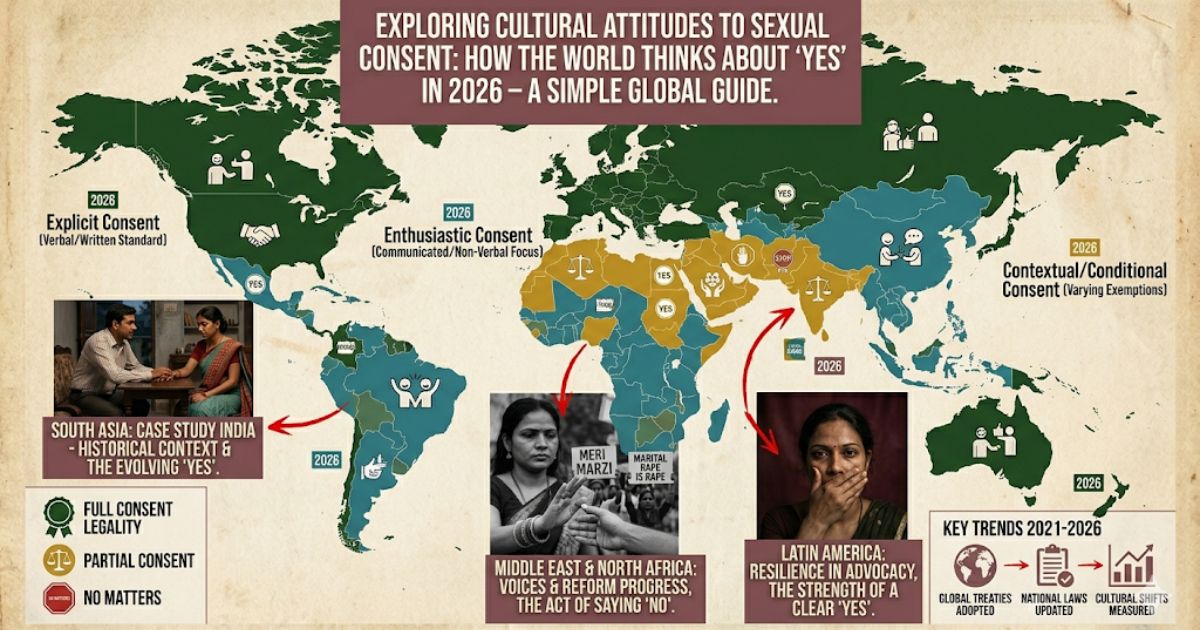
A nuanced look at how culture, conditioning, and social norms shape the meaning of consent across societies.
Read Full Article →A Short History of Marital Rape Laws
Long ago, many laws came from old English rules called “common law.” These rules said a wife became part of her husband’s property after marriage. So, sex was her “duty.” Rape laws only covered strangers or unmarried people. This idea spread to colonies in Asia, Africa, and the Americas.
For hundreds of years, judges and lawmakers said a husband could not rape his wife. It was not even called rape. Women had no legal voice.
Change started in the 1970s and 1980s. Women’s rights groups fought hard. They said every person owns their own body. Countries like Poland (1931), Sweden (1965), and Canada (1983) led the way. The United States removed the last state exemption in the 1990s. The UK made it illegal in 1991.
By the 2000s, the United Nations pushed countries to act. Reports showed only about 50 countries had clear rules against marital rape in 2011. Now in 2026, that number has grown to around 150. But progress is uneven. Many places still use old excuses like “culture” or “religion” to avoid full laws.
Global Overview of Marital Rape Laws in 2026
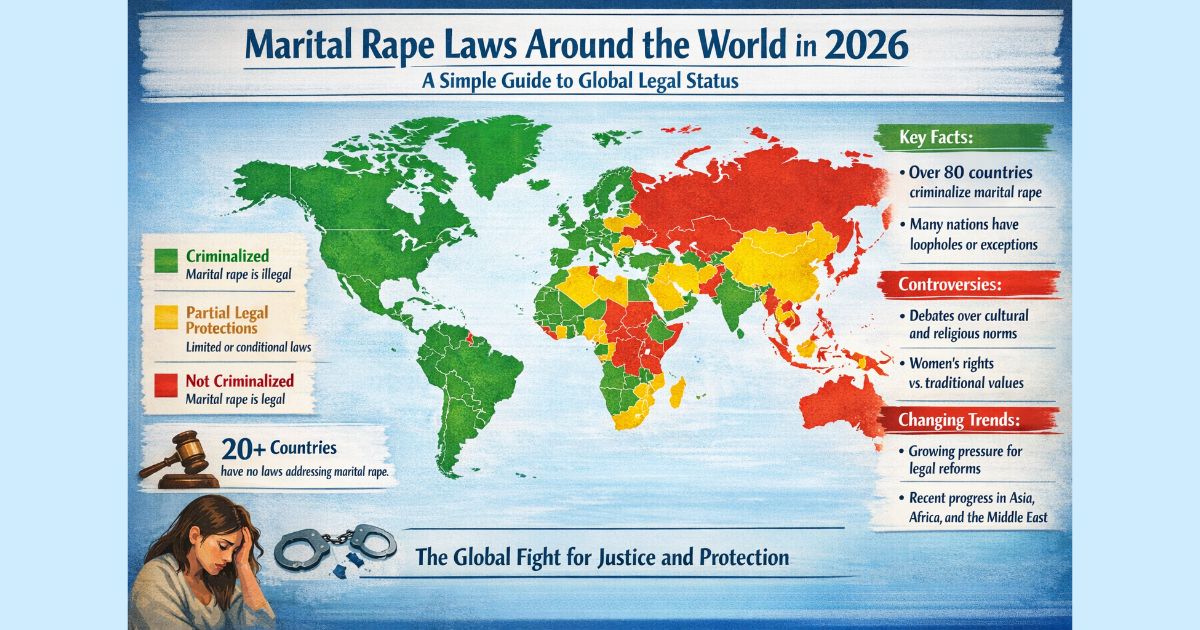
In 2026, the world is not the same. Most developed countries fully criminalize marital rape. They treat it exactly like any other rape. But in parts of Asia, Africa, and the Middle East, gaps remain.
- Explicit criminalization: About 77 countries have specific words in their laws saying “husband can be guilty of rape.”
- General laws apply: Many more use normal rape rules with no “marriage excuse.” This covers roughly 150 countries total.
- No criminalization or exemptions: Around 30-40 countries still do not treat it as rape or have clear loopholes.
- Partial rules: Some countries only punish it if the couple is separated or if extra violence happens.
According to recent reports, none of the 22 Arab League countries explicitly criminalize marital rape. In places like Jordan, Palestine (West Bank), and Syria, laws actually say marriage takes rape off the list. In Africa, countries like Ethiopia and Nigeria often exempt husbands. In Asia, India still has big limits.
Enforcement is the real problem everywhere. Even with good laws, police may not act, judges may doubt victims, and families pressure women to stay quiet. But the trend is clear: more countries are updating laws every year.
Marital Rape Laws by Region: Easy Breakdown
Let’s look region by region in simple terms. We use 2026 data from Wikipedia overviews, UN reports, and Equality Now research.
Europe
Europe leads the world. Almost every country criminalizes marital rape fully. Laws say consent matters no matter what. France got a big boost in 2025 when the European Court of Human Rights ruled that “marital duties” do not mean forced sex is okay. Germany, UK, Sweden, and Italy all have clear rules with strong penalties (often 5-20 years in prison). Even newer EU members updated their codes in the 2010s. Enforcement is better here because of training for police and support for victims.
North America
The United States criminalizes marital rape in all 50 states since the 1990s. Penalties match other rape cases. Canada made it illegal in 1983 with gender-neutral laws. Mexico has federal rules plus state support. Overall, North America has strong protections and many court cases that set examples.Latin
America and the Caribbean
Big progress here. Countries like Argentina, Brazil, Chile, Colombia, and Peru updated laws in the 2000s and 2010s. Many now add extra years to sentences for spousal rape. Bolivia (2013) and Nicaragua (2012) made it explicit. Some Caribbean islands like Barbados and Belize still have partial rules (only after separation), but most treat it seriously. Culture is shifting fast with women’s movements.
Asia
This region has the biggest mix. Good news: Thailand (2007), Turkey (2005), Cambodia (2005), Philippines, South Korea (2013 court ruling), and Singapore (full change in 2020) now criminalize it. Nepal and Pakistan have made steps forward too.
But problems remain. India does not fully criminalize marital rape for adult wives (only if the wife is under 15 or so). Bangladesh has limits for young wives. China, Myanmar, and some others lack clear rules or enforcement. In many places, family honor comes before justice.
Africa
Africa shows huge differences. South Africa, Rwanda, Liberia, Mauritius, and Zimbabwe have strong laws since the 2000s. Many added specific rules in 2010-2016.
However, countries like Ethiopia, Nigeria, Gambia, Cote d’Ivoire, Equatorial Guinea, and South Sudan do not criminalize it or say consent is automatic in marriage. Kenya has partial coverage through domestic violence acts. Tanzania and Eritrea limit it to separated couples. Customary (tribal) laws often override official rules here, making it hard for women.
Middle East and North Africa
This is the area with the least progress. As of December 2025 Equality Now report, zero of the 22 Arab League countries explicitly criminalize marital rape. Jordan, Syria, Palestine (West Bank), and others actually exclude married couples from rape definitions. Iraq, Kuwait, Saudi Arabia, and Yemen treat it as a private matter under religious or family law. Some “marry your rapist” rules still exist in a few spots (though many were removed after public pressure). Change is slow because of tradition and politics.
Oceania and Other Areas
Australia, New Zealand, and Pacific islands mostly follow strong consent-based laws like Europe. Some small nations updated recently.

A critical look at how outdated beliefs continue to blur the meaning of consent within marriage.
Read More →Spotlight on Key Countries: Real ExamplesHere are simple snapshots of important places:
- United States: Illegal in every state. No marriage defense. Victims can report to police like any rape.
- United Kingdom: Criminal since 1991. Clear court rulings protect wives.
- India: Still not fully a crime for wives over 15. Big court fights continue in 2026, but the government has resisted full change. Partial protection only for very young wives.
- France: Strong laws plus 2025 European Court win that says no “duty” excuses forced sex.
- South Africa: One of Africa’s leaders. Criminalized in 1993 with real prosecutions.
- Saudi Arabia: Not recognized as rape under current rules. Treated as family issue.
- China: No specific marital rape law. General violence rules sometimes apply but rarely.
- Nigeria: Exemptions in both north and south codes for married adults.
- Thailand: Clear crime since 2007 with heavy penalties.
These examples show how history, culture, and politics shape laws.
Recent Reforms and Positive Changes in 2026
Progress never stops. Singapore removed exemptions in 2020. Pakistan saw its first marital rape conviction in 2024 under updated rules. France’s 2025 ruling sent a message to all of Europe. Tunisia, Jordan, and Lebanon removed old “marry your rapist” parts years ago. Burkina Faso, Burundi, and Togo added clear laws in the 2010s. Women’s groups and the UN keep pushing. More countries now train judges and police on consent. Social media and education help young people demand change.
Why Do Some Countries Still Lag Behind?
Old beliefs are the main reason. Some cultures say marriage means forever consent. Religion or family traditions sometimes put “honor” above a woman’s rights. Poverty and weak governments make enforcement hard. In many places, lawmakers fear “breaking the family” if they make strong rules. But these excuses hurt real people. Studies show countries with clear laws see more reporting and less violence over time.
The Real Impact on Women and Families
Marital rape destroys lives. Women suffer injuries, unwanted pregnancies, STDs, and mental trauma. Kids in these homes grow up seeing violence as normal. Whole families break apart. Economies lose too — women miss work or cannot study. Without laws, victims feel powerless. With good laws, they get justice, counseling, and safety.
What Can You Do? Support and Help for Victims
Everyone can help. Learn about consent. Support groups that fight for law changes. If you are a victim, reach out to local women’s shelters, hotlines, or police, even if laws are weak, some help exists. Donate to global organizations like UN Women or Equality Now. Share facts on social media. Vote for leaders who support women’s rights.
In countries with good laws, report it. Therapy and legal aid are available. No one deserves forced sex.
Frequently Asked Questions (FAQ) About Marital Rape Laws
Is marital rape illegal everywhere in 2026?
No. About 150 countries say yes, but 30-40 still have no clear rule or exemptions.
Which countries do not criminalize marital rape?
Many in the Middle East (all 22 Arab League nations have no explicit law), parts of Africa (Ethiopia, Nigeria, etc.), and Asia (India for adults, Myanmar, etc.).
Does marriage mean automatic consent?
No modern law should say that. Consent must be given every time.
What is the punishment for marital rape?
It varies from several years in prison to life, same as other rape in strong-law countries.
Can a wife report her husband?
Yes in most places now. But in weak-law countries, it is harder or ignored.
Has India changed its law?
No full change yet. Courts keep pushing, but exemption remains for adult wives.
What about the US and Europe?
Fully illegal with strong enforcement.
Why is it under-reported?
Fear, shame, family pressure, and weak police response.
Are there support services?
Yes — hotlines, shelters, and NGOs in most countries. Search local “domestic violence help.”
Will laws keep changing?
Yes. Global pressure grows every year.
Conclusion: A Brighter Future Is Possible
Marital rape laws around the world have come a long way since the old days of “wives as property.” In 2026, most countries recognize that consent never ends at the altar. But the job is not finished. Gaps in Asia, Africa, and the Middle East leave millions unprotected.
Change happens when people speak up, governments act, and society shifts. Every country can do better by making laws clear, training officials, and supporting victims. Marriage should be about love and respect, not control.
If this article helped you understand global marital rape laws, share it. Knowledge is the first step to justice. Stay informed, support consent, and help build a world where every woman feels safe at home.
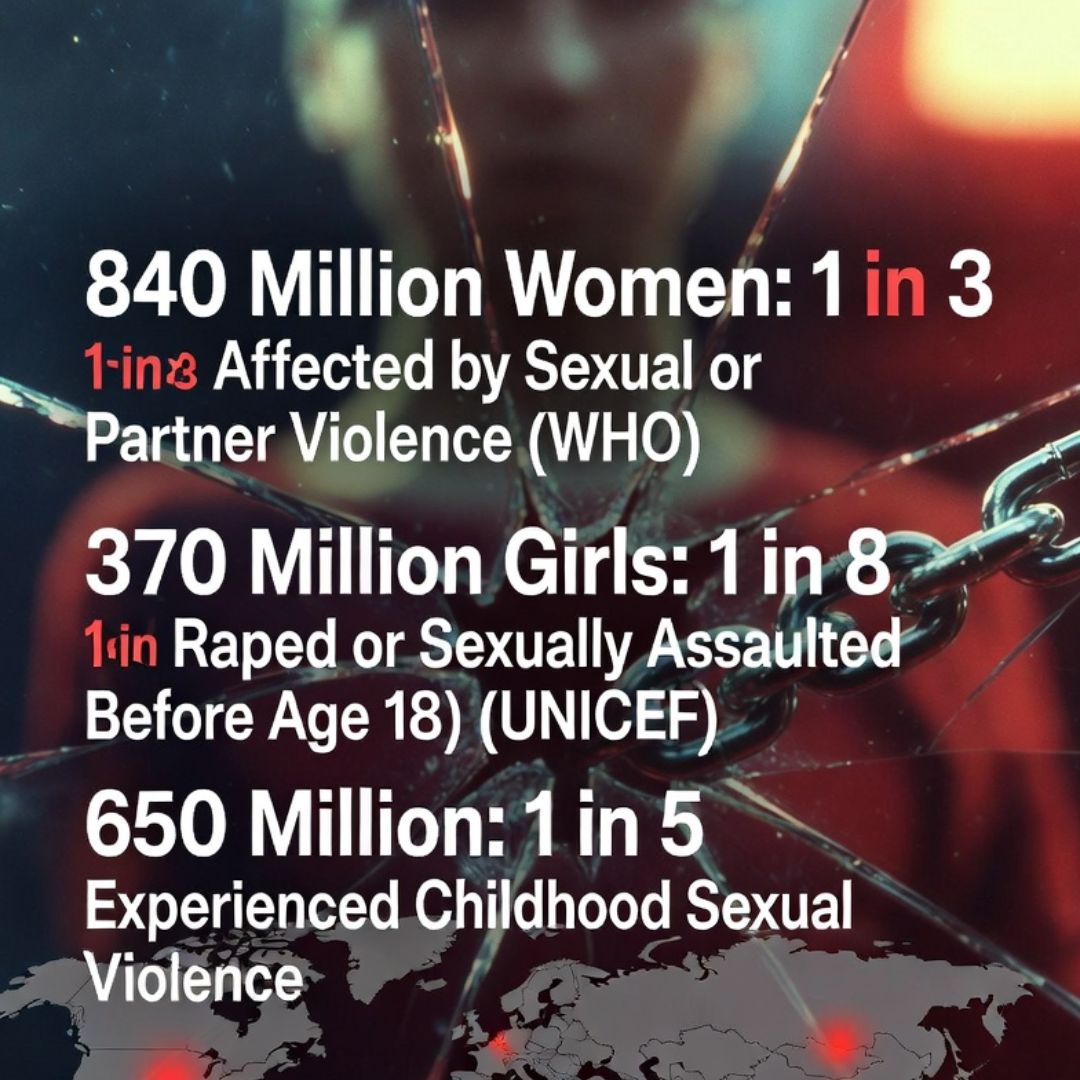
A data-backed look at how sexual violence is underreported and why countless stories remain unheard.
Read More →