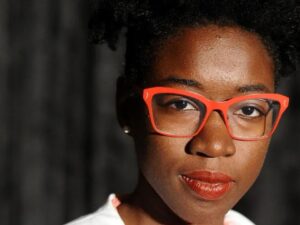

In the spring of 1977, in the bustling heart of Tehran, Iran, a girl was born who would grow up to become the first woman — and the first Iranian — ever to win the Fields Medal, the highest honor in mathematics, often called the “Nobel Prize of math.”
Maryam Mirzakhani did it without fanfare, without media training, and while battling cancer. She died at just 40, but in her short life she changed the way the world understands curved surfaces, dynamics, and the hidden symmetries of the universe.
Table of Contents
A Childhood of Stories and Numbers
Maryam grew up in Tehran during and after the Iran–Iraq War. Schools were often closed because of air raids, but she and her older brother devoured every book they could find. She originally wanted to be a writer — she loved novels and poetry — but a brilliant high-school math teacher noticed her talent and encouraged her to enter competitions.
In 1994, at age 17, she became the first girl ever to represent Iran at the International Mathematical Olympiad — and she won gold with a perfect score. The next year, 1995, she did it again: another perfect-score gold. Iran had never had a female IMO participant before her; suddenly it had a two-time champion.
She earned her bachelor’s degree from Sharif University of Technology in Tehran in 1999, then moved to the United States for graduate studies. At Harvard she worked under Curtis McMullen (himself a Fields medalist), completing her PhD in 2004 with a thesis that solved long-standing problems about the moduli space of Riemann surfaces.

The Iron Lady of Iran – Masih Alinejad
Discover the fearless journey of Masih Alinejad — a voice of women’s rights and freedom in Iran, challenging norms and advocating courage globally.
The Work That Rewrote Geometry
Most people think of mathematics as cold and abstract. Maryam’s work was anything but. She studied how complicated surfaces — think of a many-holed doughnut twisting and stretching in higher dimensions — behave over time. Her drawings looked like psychedelic art: colorful curves looping across huge sheets of paper that covered entire walls of her office.
Her tools were pencil, paper, and imagination.
Her breakthrough papers (2004–2014) gave the first proofs of several major conjectures in hyperbolic geometry, Teichmüller theory, and billiards dynamics. In 2014, at age 37, the International Mathematical Union awarded her the Fields Medal for “her outstanding contributions to the dynamics and geometry of Riemann surfaces and their moduli spaces.” She was the first woman in the medal’s 78-year history.
When reporters asked how it felt to be the first woman, she shrugged and said: “I will be happy if it encourages young female scientists and mathematicians… but I don’t think about being the first. I just do mathematics.”
Life in California, Love, and Illness
Maryam joined the faculty at Stanford University in 2008, becoming a full professor in 2014 — the same year she won the medal. She married Czech theoretical computer scientist Jan Vondrák, and in 2011 they had a daughter, Anahita.
In 2013 she was diagnosed with breast cancer. She continued working through chemotherapy, publishing major papers even while ill. The cancer returned aggressively in 2016 and spread to her liver and bones. On 14 July 2017, at Stanford Hospital, she died at the age of 40.
The news shocked the global mathematics community. Iran declared a day of national mourning. Thousands attended memorial services in Tehran and California.
A Legacy That Keeps Growing
Since her death, the impact of her work has only deepened:
- The Maryam Mirzakhani Award was created by the National Academy of Sciences (USA) for women mathematicians.
- The Breakthrough Prize established the Maryam Mirzakhani New Frontiers Prize — $50,000 given annually to outstanding women in mathematics in the early stages of their careers.
- Iran renamed a major mathematics conference in her honor, and the International Mathematical Union now celebrates “Maryam Mirzakhani Day” every year on her birthday, 12 May (chosen because she was born in the Iranian month of Ordibehesht).
In 2024, a new theorem in symplectic geometry was proved using techniques she pioneered — seven years after her death, her ideas are still opening doors that no one else could see.
Maryam once told a friend:
“The beauty of mathematics only shows itself to more patient followers.”
She followed patiently, quietly, relentlessly — and in doing so, she made the beauty visible to the entire world.