
There’s a version of this story that gets told every International Women’s Day, and it goes like this: progress is slow but steady, look how far we’ve come, here are three inspiring photographs of women in blazers pointing at documents. It’s not false, exactly. It’s just incomplete in a way that lets everyone off the hook, including us.
So here’s the less comfortable version, and it starts with a vote.
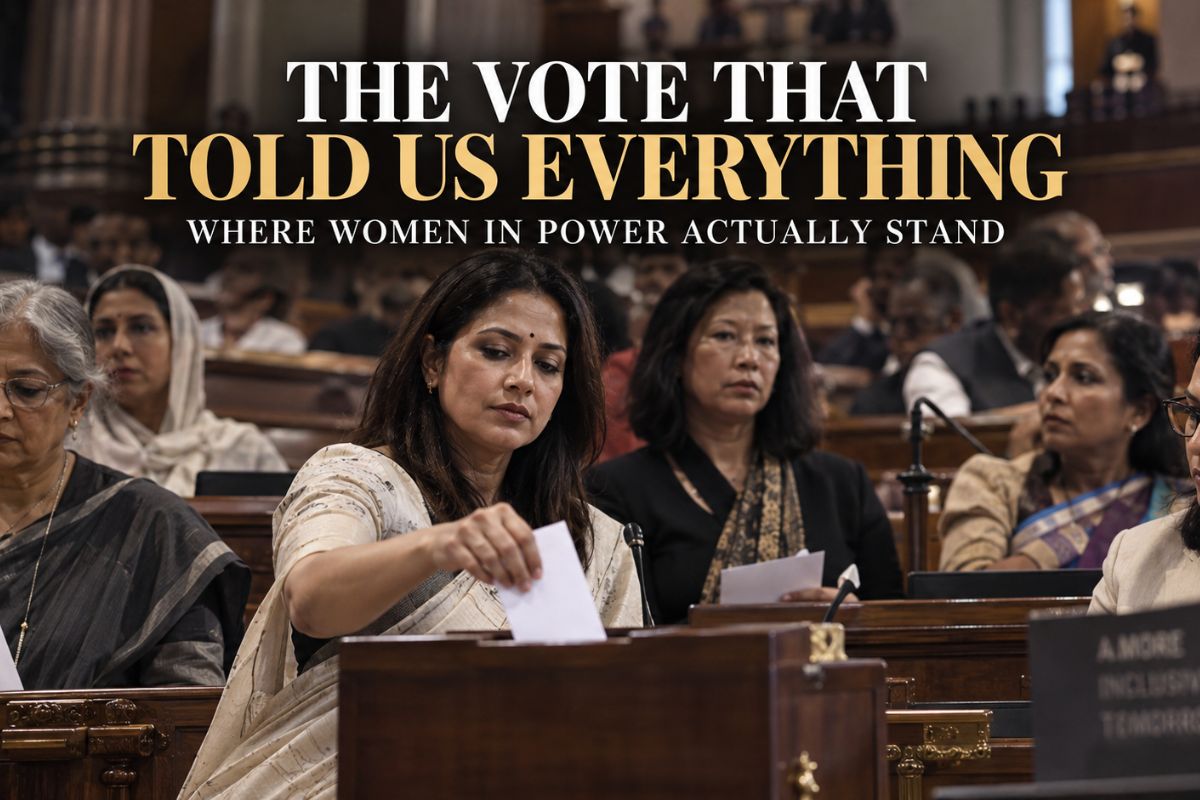
India passed a law promising women a third of Parliament in 2023. In April 2026, the attempt to actually switch it on collapsed on the floor of the Lok Sabha by 54 votes. That single vote is the real story of women in power right now, not the anniversary quotes and panel discussions: the promise exists on paper, and the paper still isn’t law.
- Globally, women hold 27.5% of parliamentary seats and just 19.9% of Speaker posts, a share that just saw its first drop in 21 years.
- In India’s 18th Lok Sabha, women hold 74 of 543 seats, roughly 13.6%, down slightly from 2019, and concentrated almost entirely in a handful of states and parties.
- The bottleneck was never really the voter. It’s the party ticket: fewer than 1 in 10 candidates fielded in 2024 were women.
- Our take: quotas fix the finish line, not the starting blocks. Until party tickets, cabinet portfolios, and committee chairs open up the same way, “reservation” risks becoming a number politicians can point to instead of power women actually hold.
The vote that exposed the gap between promise and power
On 17 April 2026, India’s government brought the Constitution (131st Amendment) Bill to the Lok Sabha. Its job was simple on paper: finally switch on the Women’s Reservation Act, the Nari Shakti Vandan Adhiniyam, that Parliament had passed almost unanimously back in September 2023, reserving a third of all seats in the Lok Sabha and state assemblies for women. The bill needed a two-thirds majority of members present and voting, which came to 352 votes. It got 298. It fell 54 votes short, and with it, the linked Delimitation Bill and the Union Territories Laws Amendment Bill were withdrawn. It was the first time in twelve years a constitutional amendment brought by the Modi government had failed on the floor of the House.
The politics of why it failed are genuinely tangled, and worth sitting with rather than flattening into a villain story. The opposition wasn’t against women’s reservation in principle, several parties said so explicitly. What they objected to was the method: the bill tied the reservation to a fresh delimitation exercise based on 2011 Census data, which would expand the Lok Sabha from 543 to 850 seats. Southern and northeastern states, which controlled their population growth earlier and more successfully than the north, argued this would permanently shrink their political weight relative to more populous northern states, punishing them for a demographic success. Their counter-demand was straightforward: implement the 33% reservation on the existing seats now, and settle delimitation as a separate question later. The government held its position that reservation had to follow, not precede, delimitation. Neither side moved, and reservation, which cleared Parliament with just two dissenting votes in 2023, is now unofficially rescheduled for the 2029 elections at the earliest, six years after it became law.
We think that gap, between what a Parliament will applaud unanimously and what it will actually implement, is the single most honest data point available on how power really works right now.
The global picture is not much kinder
If India’s story sounds like an outlier, the world data says otherwise. According to the Inter-Parliamentary Union’s most recent count, as of 1 January 2026 women hold 27.5% of parliamentary seats worldwide, up a mere 0.3 percentage points from the year before, matching 2024 as the slowest growth rate since 2017. More striking: the share of women serving as Speakers of Parliament, the person who actually controls debate, sets the agenda, and decides who gets heard, fell to 19.9%, down nearly four points in a single year and the first decline in that number in twenty-one years. Of the 75 new Speakers appointed globally in 2025, only 12 were women.
Zoom out further and the picture gets starker. Only 28 countries in the entire world are currently led by a woman as head of state or government. One hundred and one countries have never had a woman leader at all, not once, in their entire national history. Women hold just 22.4% of cabinet posts globally. The Americas remain the best-performing region at 35.6% of parliamentary seats, while quota-backed elections consistently outperform quota-free ones, chambers with legislated quotas saw women win an average of 31% of new seats in 2025, against 23% where no quota existed.
And there’s a cost to entering these rooms that doesn’t show up in seat-count tables. IPU’s most recent survey on political violence found that 76% of women parliamentarians reported experiencing psychological violence, harassment, and intimidation, both online and in person, compared to 68% of men. That’s not a footnote. It’s a structural reason talented women look at a candidacy and decide it isn’t worth it, which quietly shrinks the pipeline before a single vote is ever cast.
What India’s numbers actually look like, seat by seat
Back home, the 18th Lok Sabha, elected in 2024, seated 74 women out of 543 members, about 13.6%, a slight dip from the 78 women (14.3%) elected in 2019’s 17th Lok Sabha, which remains the historic high since Independence. For context on how far that still is from parity: the very first Lok Sabha in 1952 had 22 women members, about 4.5%. Seventy years of incremental gains have moved the needle from roughly 1 in 22 to roughly 1 in 7.
The distribution is where the real story lives. Trinamool Congress fielded the highest proportion of women candidates of any major party, and 38% of its winning MPs in 2024 were women, easily the best ratio in the country. West Bengal alone sent 11 women to the Lok Sabha, more than any other state. Meanwhile Uttar Pradesh, which holds 80 seats, the largest of any state, elected only 7 women, under 9%. Kerala initially returned zero women MPs in the general election, a number that only changed after Priyanka Gandhi Vadra won the Wayanad by-election later that year. The takeaway isn’t that Indian voters reject women candidates. It’s that most parties simply don’t nominate them in winnable seats to begin with: of the roughly 8,300 candidates who contested the 2024 general election, fewer than 800, under 10%, were women.
That single statistic, the candidate gap rather than the voter gap, is the piece we think gets buried under every headline about “record numbers” of women MPs. You cannot elect what no party nominates.
The women who are there, and what they’re doing with it
None of this erases the women who have made it into rooms that were built to keep them out, and it would be its own kind of dishonesty to write this piece as pure lament. Droupadi Murmu holds India’s highest constitutional office as President, the first tribal woman to do so. Nirmala Sitharaman has held the Finance portfolio, one of the government’s heaviest briefs, since 2019. Mamata Banerjee has run West Bengal as Chief Minister for over a decade, and her party’s candidate list is proof that a 38% figure isn’t a fantasy, it’s a choice other parties simply haven’t made. Younger MPs like Iqra Hassan, elected at 27 from Kairana, and Sanjna Jatav, elected at 26 from a Scheduled Caste-reserved seat in Rajasthan against dynastic and financial odds, are the kind of first-generation entries that quotas are actually meant to produce, women without family political capital getting a real shot. It’s worth reading alongside our feature on Air Vice Marshal Shakti Sharma breaking rank ceilings in the armed forces, a different institution but the identical pattern: the first woman in a role isn’t proof the door is open, she’s proof it can be forced.
Our take: a seat is not the same as a say
Here’s where we’ll be direct rather than diplomatic, because that’s what this section is for.
Quotas are necessary and we support them without reservation (the pun is unavoidable and we’re keeping it). But a seat-share target, even a legally mandated one, measures the wrong finish line if the starting blocks stay unequal. Reservation guarantees a woman’s name on the ballot in a designated seat. It does not guarantee she chairs the Public Accounts Committee, holds a Cabinet berth with real budgetary teeth, or gets picked as her party’s face for a state she could actually win outright. Right now, seven women hold ministerial rank in the current Union Council of Ministers, out of 72 total, and only two of those are full Cabinet ministers. Representation in the chamber and representation in the rooms where decisions get made before they ever reach the chamber floor are two different currencies, and India, like most of the world, has been generous with the first and stingy with the second.
The uncomfortable implication is that the 131st Amendment’s collapse might matter less than we instinctively want it to. Even a fully implemented 33% reservation, arriving on schedule in 2029, would put more women in seats without a single structural change to who chairs committees, who gets fielded from strong general seats rather than reserved ones, or who a party actually trusts to win without a quota’s help. We’d rather see parties do voluntarily, right now, in 2026, what TMC has already shown is possible with candidate lists, than wait three more years for a law to force a number that still won’t touch the deeper question of authority.
The pattern echoes something we’ve written about before in a completely different context, the invisible tax women pay for being agreeable rather than assertive in ordinary workplaces. Read that alongside this, and the throughline is uncomfortable: the “Nice Girl” tax that stalls a woman’s career in a corporate office is the same instinct, scaled up, that hands a woman a reserved seat but not a Cabinet berth. Being included is not the same as being trusted with power, and both need fixing, not just the first one.
Where this leaves us
Reservation, when it does arrive, will still be worth celebrating. A third of the Lok Sabha reserved for women is not a small thing, and the countries that got there first, Rwanda, Bolivia, the Nordic bloc, all needed some version of a legal push before culture caught up on its own. But we’d be doing our readers a disservice if we treated the 2023 unanimous vote as the finish line and the April 2026 defeat as a minor procedural hiccup on the way there. It’s the opposite. The unanimous vote was easy, symbolic votes always are. The 54-vote defeat is what happens when a promise meets the actual, unglamorous mechanics of who keeps power and who’s asked to wait for it.
We’ll keep tracking this one, alongside every state assembly election between now and 2029, on our Politics desk and under our running Women in Politics coverage. If you want the fuller roster of the women already rewriting what these institutions look like, our Change Makers series is the place to start.
Sources: Inter-Parliamentary Union, “Women in parliament 2025” report and “Only 1 in 7 countries is led by a woman” release (both March 2026); PRS Legislative Research, Profile of the 18th Lok Sabha; Election Commission of India 2024 candidate data; Wikipedia and multiple current-affairs summaries on the Constitution (131st Amendment) Bill, 2026, cross-checked against The Wire’s April 2026 floor-vote reporting.

1 thought on “The Vote That Told Us Everything: Where Women in Power Actually Stand”