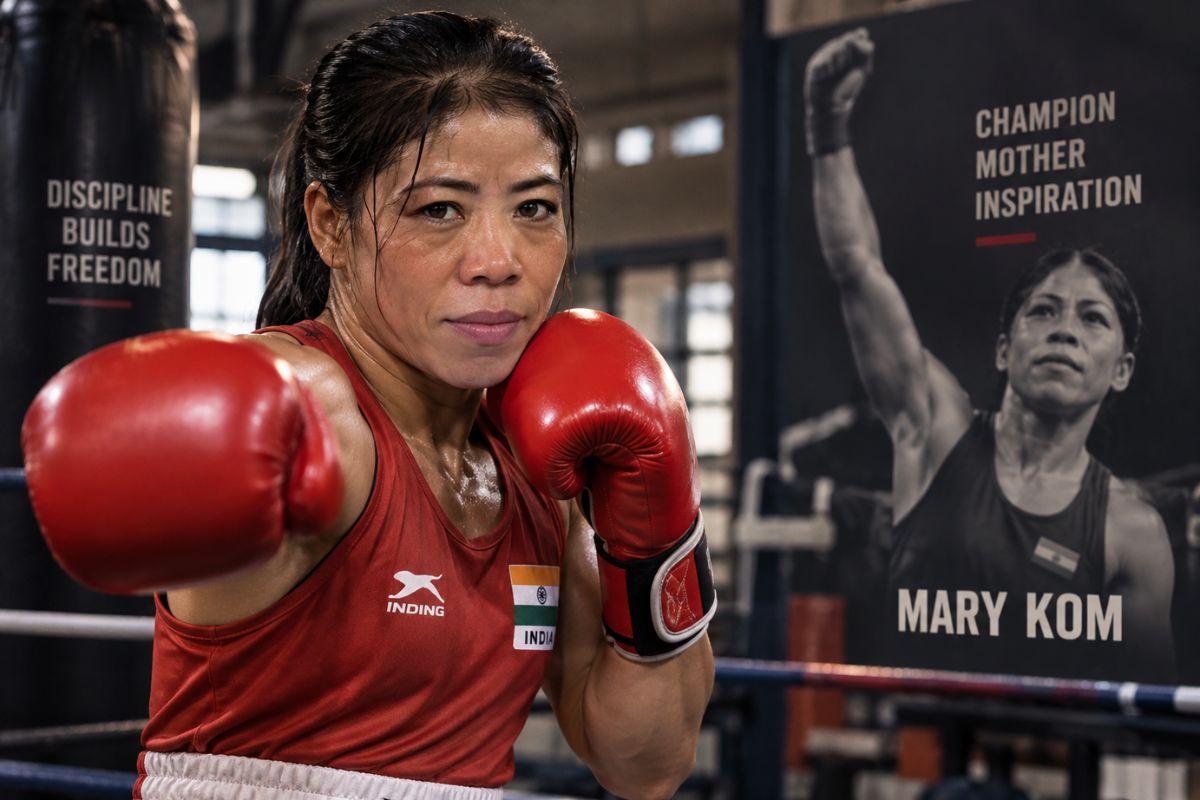
She rose from the hills of Manipur with nothing but grit in her fists and an unshakable will. Mary Kom, known to the world as Magnificent Mary, turned a sport once closed to women in her community into a stage for national pride. She did not merely win medals. She rewrote what was possible for a girl from a remote village in India’s Northeast.
Born Mangte Chungneijang Mary Kom on 1 March 1983 in the small village of Kangathei in Churachandpur district, Manipur, she grew up in a family of tenant farmers. Her parents, Mangte Tonpa Kom and Akham Kom, worked the fields and struggled to provide even basic necessities. Mary was the eldest of three children. Life meant hard labour from an early age. She helped on the farm, walked long distances to school, and learned early that nothing would be handed to her.
Athletics came naturally. She excelled in running and the javelin. Then, in 1998, fellow Manipuri boxer Dingko Singh won gold at the Asian Games. That victory lit a fire. Boxing was considered a man’s game. Society frowned on girls entering the ring. Her father, once a wrestler himself, was initially against it. Mary trained in secret at first, slipping away to practice. When her photograph appeared in the newspaper after she became state champion, the truth came out. Slowly her family accepted the path she had chosen.
In 2001, still a teenager, she stepped onto the world stage at the inaugural Women’s World Boxing Championships in Scranton, USA. She returned with a silver medal. The next year, in Antalya, Turkey, she claimed her first gold in the pinweight category. It was the beginning of a reign that would last nearly two decades. She won world titles again in 2005, 2006, 2008, and 2010. After becoming a mother of twins in 2007, she returned stronger than before and added more golds. In 2018, competing on home soil in New Delhi, she captured her sixth world championship title, becoming the first woman in history to achieve that feat. No other boxer, male or female, has collected eight medals at the World Championships.
The 2012 London Olympics marked a different kind of triumph. Women’s boxing made its Olympic debut that year, but only in three weight classes. Mary’s preferred category was not among them. She moved up to the 51 kg flyweight division, fighting taller and heavier opponents. She was the only Indian woman boxer to qualify. In the ring she displayed the same aggression, speed, and power that had defined her career. She reached the semi-finals and claimed bronze, India’s first Olympic medal in women’s boxing. On the day of her opening bout her twins turned five. The medal was more than personal success. It was a statement for every girl told that certain dreams were not for her.
She continued to collect firsts. In 2014 she became the first Indian woman boxer to win gold at the Asian Games in Incheon. In 2018 she repeated the feat at the Commonwealth Games in Gold Coast, again the first Indian woman to do so. She was ranked world number one in her category more than once. She won multiple Asian Championship titles. Through it all she remained a mother first, balancing rigorous training with raising her children. She later adopted a daughter as well.
Mary Kom never boxed for fame alone. She opened an academy in Manipur to train young boxers free of cost, giving children from similar backgrounds the chance she once fought for. She was nominated to the Rajya Sabha, India’s upper house of Parliament, where she spoke for sports, for the Northeast, and for opportunities that reach beyond privilege. The government recognised her with the Arjuna Award, the Rajiv Gandhi Khel Ratna, the Padma Shri, the Padma Bhushan, and later the Padma Vibhushan.
Her story is one of quiet defiance. She faced poverty, social resistance, the physical demands of motherhood, and the challenge of changing weight categories late in her career. Each time she answered in the ring. She showed that excellence does not require perfect conditions. It requires consistency, courage, and the refusal to accept limits set by others.
Today Mary Kom stands as more than a champion. She is proof that a girl from a distant village can force the world to take notice. She carried the hopes of a region often overlooked and turned them into medals that belong to the entire nation. In every punch she threw, she declared that talent and determination can overcome barriers of geography, gender, and circumstance. Her legacy is not only the titles she won but the doors she opened for those who follow.