
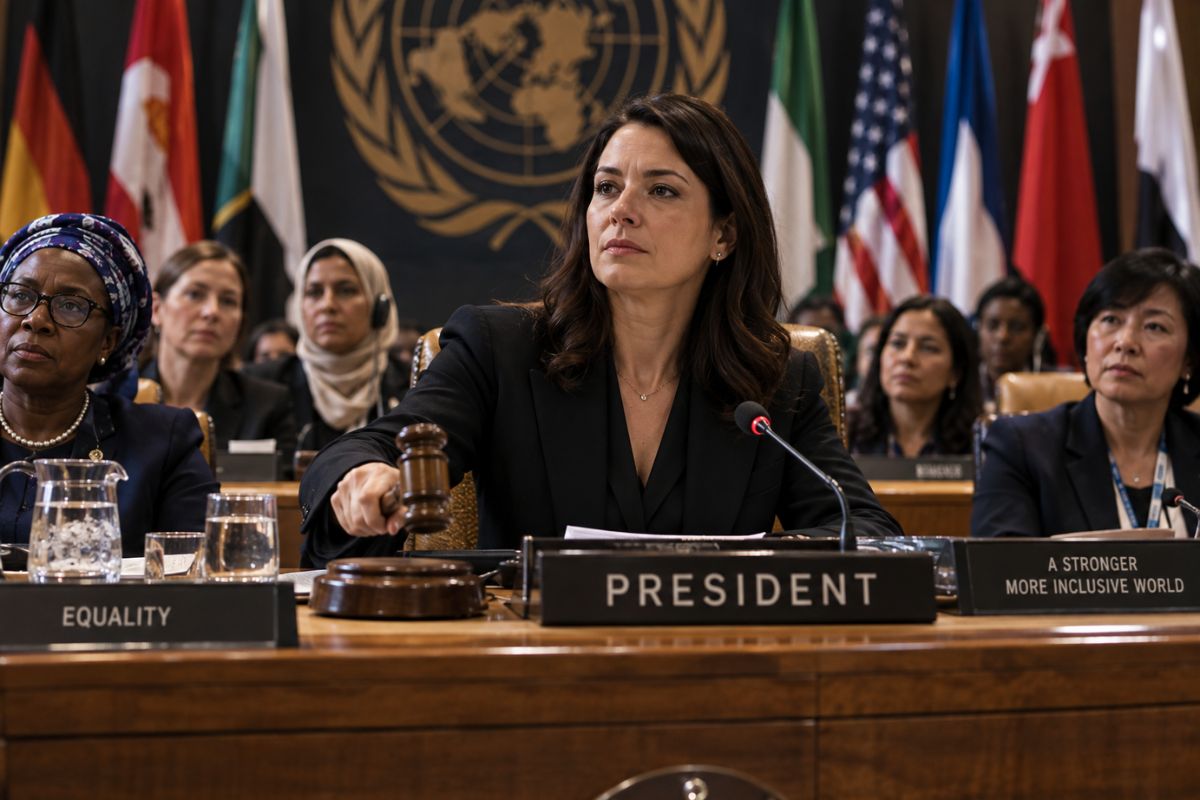
As of 1 January 2026, women hold 27.5% of national parliamentary seats across the world, according to the Inter-Parliamentary Union’s newest count, up from 27.2% the year before. It sounds like progress, and technically it is. It’s also the slowest rate of growth since 2017, and the second year running that the increase has landed at a flat 0.3 percentage points. At this pace, depending on which projection you trust, parity is still decades away.
But the seat count was never the number that mattered most to us. The number that matters is who’s holding the gavel.
Women hold more parliamentary seats worldwide right now than at any point in history, 27.5%, and that number just posted its slowest growth in nearly a decade. Meanwhile the share of women actually running a chamber as Speaker just fell for the first time in 21 years. Those two facts happening in the same year is the whole story: getting into the room and running the room are not the same fight, and the world just lost ground on the second one.
- Only 28 countries on Earth are currently led by a woman. 101 countries have never had one, not once.
- Six countries, led by Rwanda at roughly 64%, now have more women than men in their national legislature. The United States sits outside the global top 60.
- Where quotas exist, women win an average of 31% of seats. Where they don’t, it’s 23%. The law, not the electorate, is usually the bottleneck.
- Our take: a seat count without a Speaker’s gavel is decoration. The next real milestone isn’t 30% of parliament, it’s 30% of parliaments actually run by women.
The number that actually moved, and moved the wrong way
In the same reporting period, the share of women serving as Speaker of Parliament, the person who runs debate, sets the legislative calendar, and decides whose amendment gets heard and whose gets buried, fell to 19.9%. That’s a nearly four-point drop from the year before, and IPU says it’s the first decline in that particular figure in 21 years. Of the 75 new Speakers appointed or elected globally across 2025, only 12 were women, 16%.
Sit with that gap for a second. Women are, slowly, filling more seats than ever. But the specific seat that converts a legislative body from a debating chamber into a functioning institution, the chair, is going in the opposite direction. A parliament can be a third female and still run entirely on rules, timing, and priorities set by men, because the person who decides which bills get floor time hasn’t changed. That’s not a technicality. It’s the actual mechanism by which representation without authority happens.
Who’s actually running countries, and who never has
Zoom out from parliaments to heads of state and government, and the picture gets starker still. As of early 2026, only 28 of the world’s roughly 193 countries are led by a woman, whether as president, prime minister, or chancellor. Set against that, 101 countries, more than half the planet’s nations, have never had a woman as their top leader. Not one, not ever, in their entire independent history.
There was real movement in 2025 specifically: Japan, Namibia, and Suriname each installed a woman as head of government for the first time ever. Namibia’s Netumbo Nandi-Ndaitwah, Japan’s first woman prime minister, and Suriname’s leader all broke a ceiling that had held since those countries’ founding. Ireland elected Catherine Connolly as its president in November 2025, its 11th president overall and part of a genuine pattern in Irish politics of women in the country’s top constitutional office. Bulgaria’s Iliana Iotova stepped up from vice president to president in January 2026. Costa Rica elected Laura Fernández Delgado in May 2026, continuing a Latin American trend of women reaching presidencies with real executive teeth, not just ceremonial ones.
And then there’s the cautionary tale that gets left out of the celebratory lists. Sheikh Hasina of Bangladesh was, by total time in office, the longest-serving woman head of government in the modern era, more than twenty cumulative years in power. In 2024 she resigned and fled the country as protests against her government, which began over a public-sector jobs quota, turned into a mass uprising. Longevity in office, it turns out, is not the same thing as a secure or accountable hold on power, for a woman leader any more than for a man. We’d rather include that story than leave it out, because a list of firsts that skips the falls isn’t an honest list.
Six countries have already crossed the line most of the world hasn’t reached
Here’s the part of this conversation that rarely gets its due weight: gender parity in a national legislature isn’t hypothetical. It already exists, right now, in a handful of countries, and it has for years in the case of the frontrunner.
Rwanda’s parliament has been majority female since 2008, and currently sits at roughly 64%, nearly two-thirds of its lower house. That’s not a cultural accident. It followed directly from Rwanda’s 2003 constitution, drafted in the aftermath of the 1994 genocide, which legally reserved a minimum 30% of legislative seats for women as the country rebuilt a society where women made up the clear demographic majority. Cuba follows at roughly 55.7%, Nicaragua at around 55%, with Mexico, Andorra, and the United Arab Emirates each sitting at or near 50%. After its 2025 elections, Bolivia joined that small club too, bringing the global count of countries with gender parity or better in their national legislature to seven.
Every single one of these got there through binding legal quotas, not organic cultural change that arrived on its own timeline. That pattern holds globally too: IPU’s 2025 data shows that in the 49 countries that held parliamentary elections that year, chambers operating under some form of legislated gender quota saw women win an average of 31% of seats, against just 23% in chambers with no quota at all. If you’re looking for the single most effective policy lever in this entire conversation, it’s not awareness campaigns or voluntary party pledges. It’s law with teeth.
Compare that to the United States, still sitting around 27th to 67th globally depending on which chamber and which year’s count you use, well outside the world’s top tier, with no binding quota system at any level of federal politics.
What it costs to stay in the room
None of this progress, real or stalled, is happening in a vacuum, and it isn’t free. IPU’s most recent study on political violence found that 76% of women parliamentarians reported experiencing psychological violence, harassment, or intimidation, both online and in person, compared to 68% of men surveyed. A separate regional study of the Asia-Pacific found the same pattern at similarly high rates. This isn’t background noise to the representation numbers, it’s a direct input into them. Every woman who looks at that kind of exposure and decides a candidacy isn’t worth it is a data point that never shows up in a seat-count table, because she never ran in the first place. The pipeline shrinks before a single ballot is printed, and no quota law touches that part of the problem.
Our take: stop grading on the seat count alone
We’ll say plainly what the data above adds up to. The world has gotten reasonably good, over the past three decades, at putting women into parliamentary seats. It has made almost no comparable progress on putting women in charge of what those parliaments actually do, and 2025 was the year that gap became impossible to wave away: seats up marginally, Speakerships down sharply, in the same twelve months.
We think the next benchmark worth tracking isn’t “30% of parliament is female” as a global target, the world is already closing in on that slowly. It’s what percentage of parliaments are actually run, gavel in hand, agenda in hand, by a woman. By that measure the world isn’t at 27.5%. It’s under 20%, and for the first time in over two decades, it just got worse instead of better. A seat is a voice in the room. The chair is who decides whether the room listens.
That’s also why the quota-versus-culture debate, the argument you’ll hear from critics who say legislated gender quotas are patronizing or artificial, misses the more useful question. Rwanda, Mexico, Cuba, and Bolivia didn’t get to parity by waiting for culture to shift organically; they wrote a floor into law and let the culture catch up around it. Critics of that approach argue it can install women into seats without necessarily building the deeper political infrastructure, mentorship, party pipelines, fundraising networks, that lets them rise to leadership within those chambers once they’re seated, and that’s a fair caution worth taking seriously rather than dismissing. But the counterfactual is sitting right there in the global data: the 23%-versus-31% gap between quota and no-quota chambers is the actual, measured size of what “waiting for culture” costs in the meantime.
Where we’re watching next
We’ll be tracking the Speakership numbers specifically through the rest of 2026, since a single-year drop after 21 years of gains is either a blip or the start of a trend, and it’s too early to know which. We’re also watching whether any of 2025’s four newly elected women heads of government, in Japan, Namibia, Suriname, and Ireland, get a second term, since one term is a headline and two terms is evidence of something sturdier.
If you want the fuller, ongoing thread on this, our Politics desk and running Women in Politics coverage carry it forward country by country, and our global edition at realshepower.com is tracking the same story for readers outside India.
Sources: Inter-Parliamentary Union, “Women in parliament 2025” report and accompanying 2026 IPU–UN Women data releases; IPU report “When the public turns hostile: Political violence against parliamentarians” (2026); Council on Foreign Relations, Women’s Power Index; Pew Research Center analysis of CFR data, March 2026; Council of Women World Leaders current officeholder list, January 2026; IPU Parline global rankings on women in national parliaments.