
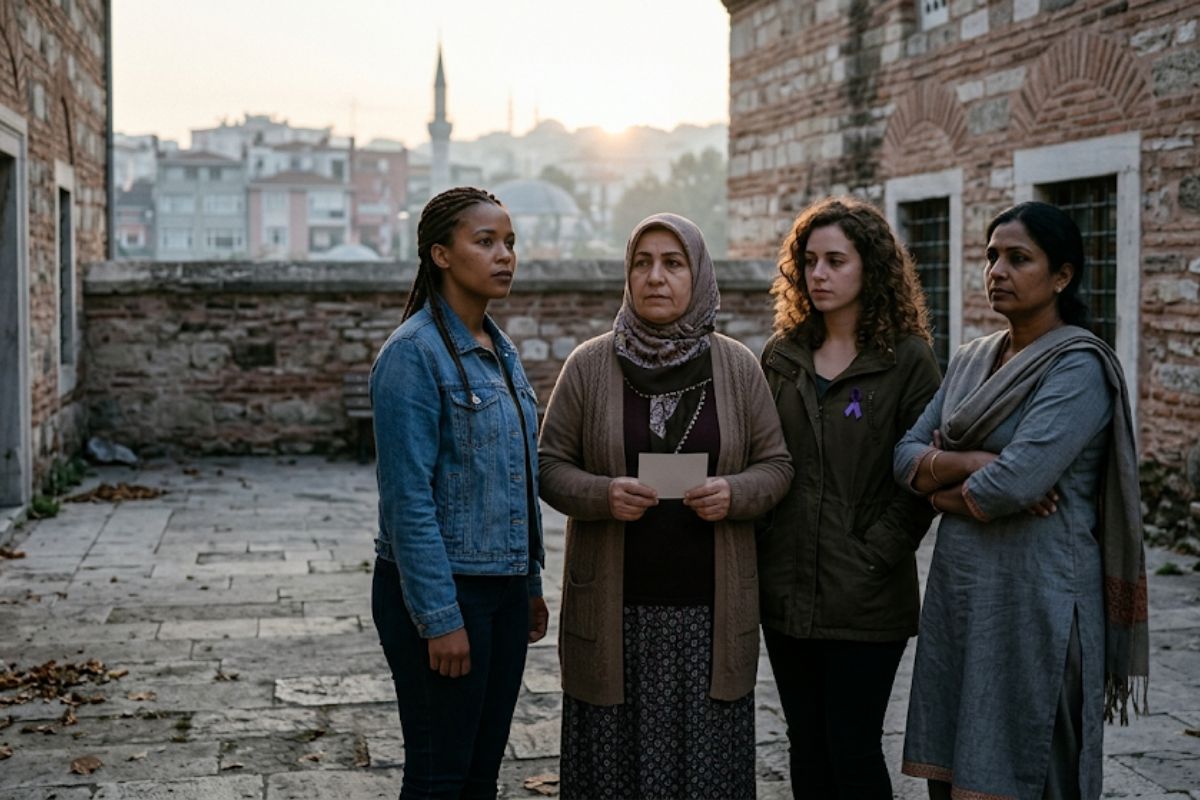
September 2026 exposed the raw persistence of violence against women across continents. Bodies were found, partners were arrested, and communities protested. The month did not invent the crisis. It simply made visible what happens every day when protection systems fail and violence from intimate partners or strangers continues unchecked.
South Africa: Bodies in Ekurhuleni
In the Ekurhuleni area east of Johannesburg, police recovered multiple women’s bodies in September as part of a string that began in July. By late September the total reached at least 11. Many of the women were in their 20s and 30s. Several were found partially clothed or naked, with signs of sexual assault and severe beating.
Elizabeth “Tsontso” Moselakgomo, 38, a mother and regular runner, left for her usual afternoon jog after work around 9 September. Her half-naked body was found days later, her face so badly beaten it was hard to recognise. Other victims included Dineo Motapane, 38, whose battered and partly burned body was discovered, and Gracious Nkomo, 28, found dumped near a highway. One body was found at a cemetery in Tembisa on 26 September. Another woman was shot while walking to work.
Police arrested suspects in connection with at least three of the cases and collected DNA and other forensic evidence. They have not confirmed a single serial killer is responsible for all the deaths. President Cyril Ramaphosa addressed the nation, called the violence a “national shame,” and ordered reviews of unsolved gender-based violence cases, safety audits of high-risk areas, and faster forensic processing. South Africa already records one of the world’s highest rates of intimate-partner femicide, roughly five times the global average.
Turkey: 27 women killed by men
According to monitoring by bianet, men killed at least 27 women in Turkey during September. Twenty-one of them died at the hands of husbands, boyfriends or former fiancés. Nine were killed because they wanted to end the relationship or refused to reconcile. At least 52 other women were injured, 19 children were abused, and 28 women were harassed. The group listed names including Ayfer Ç., Ayşe K., Berfin Zelal Kaya, and Nalan Temelkıran.
Spain: Rising official femicide count
Spain’s official tally of women killed by gender-based violence climbed through the month. By late September the figure for 2026 stood at 38 to 40. Specific cases included Cristina, 34, found dead in her home in Leganés (Madrid) on 19 September; her 35-year-old partner was arrested. An 88-year-old woman was killed by her husband in Madrid on 11 September. A 47-year-old woman was killed in Seville on 26 September, and a 33-year-old woman was killed in Benidorm on 27 September. In many of these cases there were no prior formal complaints.
Argentina: 27 fatal cases in one month
Monitoring groups recorded 27 fatal victims of gender-based violence in Argentina in September alone. Camila Ruth Castro, 18, was shot by her former partner on 8 September in Ituzaingó. Camila Vecchiarello, 26, a nursing student who was pregnant, was stabbed multiple times in San Juan by her husband. Mónica Ligorria was shot while working at an egg stall in Pilar on 21 September by her former partner; she had a restraining order and panic button. Overall, groups reported around 192 to 200 fatal gender-violence cases in the first nine months of 2026, with many children left motherless.
Other documented cases
In El Salvador, feminist groups recorded at least seven violent deaths of women in the first three weeks of September, five of them classified as femicides. Names included Joysi Villalta and Kenia Osiris Portillo. The month stood as the highest so far in 2026 for such killings.
In Italy, Lorena Isceri, 45, was abducted by her former partner on 3 September near Florence, forced into a car boot, and thrown from a motorway bridge. He then jumped himself. The case formed part of a cluster of partner or ex-partner killings that raised the annual count.
In Cuba, Rachel García González, 27, a mother of four girls, was killed by her partner on 28 September in Camagüey. Independent monitors put the year’s verified femicides at 55 by the end of the month.
In Bangladesh, Mahila Parishad recorded 252 women and girls subjected to violence in September. This included 49 rape cases (30 involving girls), 52 killings, and 45 deaths under mysterious circumstances. Four girls were killed after rape.
In India’s Delhi-NCR region, at least 13 alleged rape and sexual assault cases were reported in September. On 21 September three men posing as police officers allegedly gang-raped a 17-year-old girl in Aastha Kunj Park. Earlier, a 16-year-old girl’s body was found after she was allegedly gang-raped and murdered. Other cases involved younger children. Police made arrests in several of the incidents. The Supreme Court later noted systemic failures in public safety.
Where the world stands
These September cases are not isolated. United Nations data show that roughly 50,000 women and girls are killed each year by intimate partners or family members. That works out to about 137 every day, or one every ten minutes. Africa records the highest numbers and rates. Most of these killings happen inside homes or by people the victims know.
Laws against domestic violence, femicide and rape exist in many of the countries named above. Special units, helplines and court protections have been created. Yet the same patterns repeat: previous complaints ignored, restraining orders not enforced, forensic backlogs, under-reporting, and social tolerance of controlling behaviour. In high-rate settings the everyday risk is extreme. In lower-rate settings the absolute numbers still add up because the violence is concentrated in private relationships.
Progress is slow. Global estimates of intimate-partner violence have barely declined over two decades. Data gaps remain large in many regions, so the true scale is higher than reported figures. September 2026 simply put faces, names and local outcry to a problem that is continuous. Women continue to die because the people closest to them choose violence and the systems meant to stop it arrive too late or not at all.