
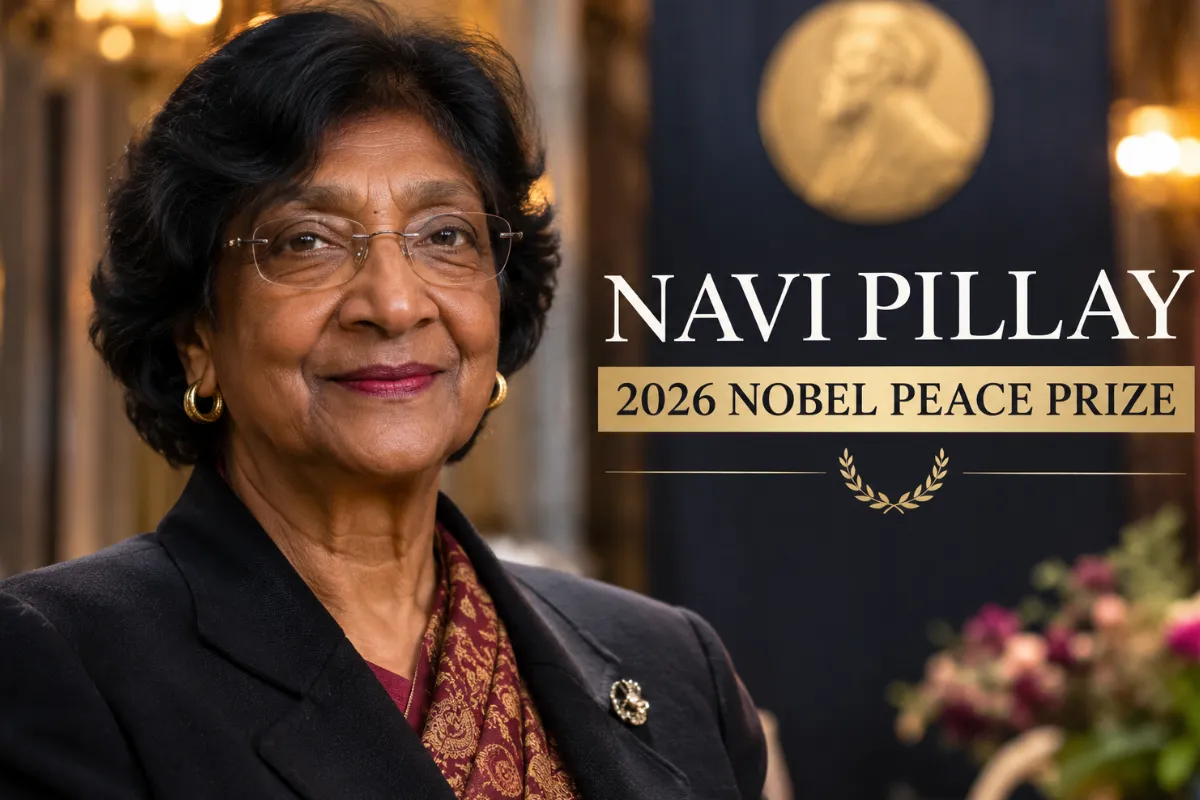
In a world still grappling with conflict, inequality, and threats to the rule of law, few figures stand out as powerfully as Navanethem “Navi” Pillay. The South African jurist and human rights defender received the 2026 Nobel Peace Prize for her decades-long efforts to promote peace and international law. At 85, this pioneering woman continues to embody resilience, courage, and an unwavering commitment to accountability—qualities that make her one of the most inspiring and talk-worthy women of our time.
Pillay’s story is not one of overnight fame. It is a lifetime of quiet, determined work against apartheid, genocide, war crimes, and systemic injustice. Her recognition as the 2026 Nobel Peace Prize laureate highlights how one woman’s persistent pursuit of justice can reshape global norms and offer hope to victims worldwide.
Early Life and the Fight Against Apartheid
Born on September 23, 1941, in Durban, South Africa, under the brutal system of apartheid, Navi Pillay faced discrimination from an early age as a woman of Indian descent. Education became her pathway forward. She studied law and, in 1967, became the first woman to establish a law practice in Natal province (now KwaZulu-Natal).
As a young lawyer, she defended anti-apartheid activists, including those connected to Nelson Mandela’s struggle. She challenged discriminatory prison conditions and fought for basic human dignity in a system designed to deny it. These early battles forged her commitment to the principle that no one is above the law and that the most vulnerable deserve protection.
After the end of apartheid, Pillay made history again as the first woman of color appointed as a judge on South Africa’s High Court. Her domestic achievements laid the foundation for an extraordinary international career.
Landmark Contributions to International Criminal Justice
Pillay’s global impact accelerated when she joined the International Criminal Tribunal for Rwanda (ICTR). There, she played a pivotal role in groundbreaking legal developments. She helped establish that rape and sexual violence could constitute acts of genocide and crimes against humanity—a historic recognition that transformed how international courts address gender-based violence in conflict.
She later served as a judge on the International Criminal Court (ICC) and as United Nations High Commissioner for Human Rights from 2008 to 2014. In these roles, she strengthened mechanisms for accountability, advocated for victims, and pushed states and leaders to uphold international legal standards.
More recently, Pillay chaired the UN Independent International Commission of Inquiry on the Occupied Palestinian Territory. The commission’s work, including findings related to events in Gaza, underscored her continued willingness to apply rigorous legal analysis to highly charged situations. She has also served as an ad hoc judge at the International Court of Justice in cases involving allegations of genocide.
The Norwegian Nobel Committee praised her for significantly enlarging the scope and impact of international law through judicial rigor, personal integrity, and considerable courage. They described her as one of the great defenders of international legal principles in our time, someone who has brought hope to victims of violence and conflict while holding both individuals and states accountable.
Why Navi Pillay’s Achievement Matters in 2026
The 2026 Nobel Peace Prize arrives at a moment when the international legal order faces intense pressure. By honoring Pillay—the first person awarded the prize primarily for her work as a judge—the committee sent a clear message about the enduring value of independent institutions, evidence-based inquiry, and the rule of law over force.
Her recognition is particularly meaningful as only the 21st woman to receive the Nobel Peace Prize. It celebrates not just individual brilliance but the broader contribution of women who have advanced justice often from the margins. Pillay’s career demonstrates that progress in human rights frequently comes through sustained, less-visible work in courtrooms, commissions, and legal scholarship rather than solely through political power or celebrity.
At an age when many retire, Pillay remains active. Her continued service on international bodies and her public commentary reinforce that the fight for justice is lifelong. Supporters and observers note that her award has drawn significant global attention, reflecting widespread desire to reaffirm the importance of international law.
Lessons from an Extraordinary Life
Navi Pillay’s journey offers powerful lessons for anyone seeking to make a difference:
- Persistence over decades matters. Her impact accumulated through consistent effort across different institutions and eras.
- Legal tools can create lasting change. By expanding definitions of crimes and strengthening accountability mechanisms, she altered how the world responds to atrocities.
- Courage includes speaking difficult truths. Whether confronting apartheid, documenting genocide, or chairing sensitive inquiries, she prioritized evidence and principle.
- Representation creates pathways. As a pioneering woman of color in South African and international law, she opened doors for others.
These qualities explain why her story resonates so strongly in 2026. In an era of polarization and institutional strain, Pillay represents the steady, principled pursuit of a more just world.
A Legacy That Continues to Inspire
The Nobel Peace Prize ceremony in Oslo on December 10, 2026, will formally honor Pillay’s contributions. Yet her true legacy already lives in the legal precedents she helped set, the victims who found a measure of justice through the institutions she strengthened, and the new generations of lawyers and advocates she has inspired.
Navi Pillay is more than a current known woman who has done something amazing. She is a living example of how one determined individual can expand the reach of justice across borders and generations. Her story deserves to be talked about widely—not only as recognition of past achievements, but as a call to continue the unfinished work of building a world governed by law rather than might.
In celebrating Navi Pillay, we celebrate the enduring power of integrity, the critical role of women in advancing human rights, and the possibility that determined effort can still move the needle toward peace and accountability. Her life stands as a compelling reminder that the most profound impact often comes from those who refuse to look away.