
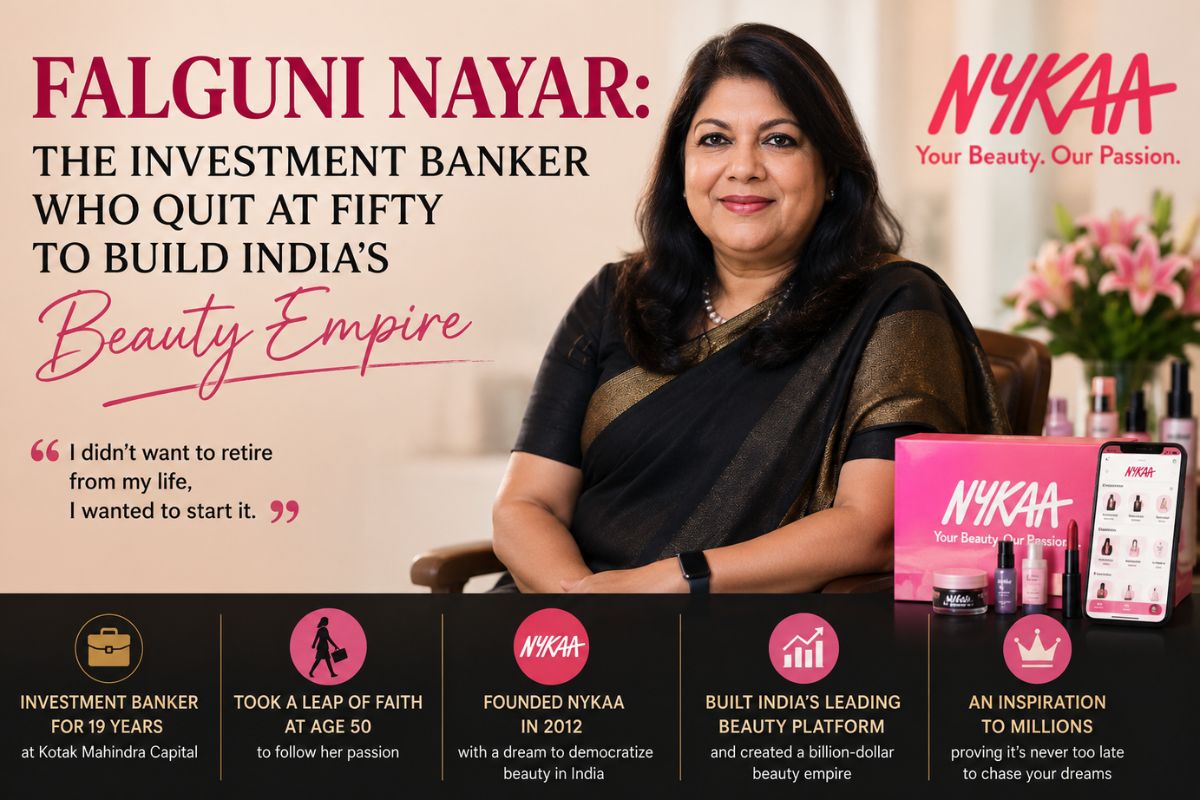
Most founder stories begin with someone young, restless, and unwilling to wait. Falguni Nayar‘s begins with a woman at the peak of a nineteen year investment banking career, managing director of Kotak Mahindra Capital, running the firm’s international operations across London, New York, and Singapore, deciding at forty nine that the safest job in the world had started to feel like the riskiest place to stay. She quit anyway, poured close to two crore rupees of her own savings into a company she had never run in an industry she had never worked in, and built it, over the following decade, into a beauty retail empire worth well over a trillion rupees. Nykaa’s story is often told as an overnight beauty industry disruption. It is really a story about what nineteen years of watching other people build companies eventually teaches you about building your own.
Two Decades On The Other Side Of The Table
Nayar’s early career gave almost no hint of where it would eventually lead. Born in 1963 to a Gujarati business family in Mumbai, she studied commerce at Sydenham College before earning an MBA in finance from the Indian Institute of Management, Ahmedabad. She briefly worked as a management consultant before joining Kotak Mahindra in 1993, where she spent the next nineteen years rising through the investment banking ranks, eventually becoming managing director of Kotak Mahindra Capital and helping build the firm’s presence in London and New York. For nearly two decades, her job was sitting across the table from India’s most ambitious founders, evaluating their businesses, structuring their public offerings, and watching them take the kind of risk she had spent her entire career advising rather than taking herself.
The Deadline She Set For Herself
Nayar has been candid in interviews about the specific, almost clinical way she approached leaving. She set herself an internal deadline of fifty, reasoning that comfort has a way of quietly hardening into complacency the longer a person waits, and that if she did not leave a job “where everything was going right” before that age, she likely never would. Her own son, when she first floated the idea, asked her directly whether it might look like a midlife crisis. She has said she considered the question seriously, and decided the risk was worth taking anyway. In 2012, with her twin children away at university in the United States and a gap in her schedule she had not had in years, she walked away from Kotak and began building what would become Nykaa, working initially out of her own living room.
Betting On A Gap She Had Noticed From The Outside
The idea itself came from a genuinely simple observation. India in 2012 had no dedicated, trustworthy online destination for beauty products, brick and mortar stores offered limited selection at a premium, counterfeit cosmetics were common, and general e-commerce platforms could not reliably guarantee authenticity. Nayar, inspired by curated beauty retailers like Sephora abroad, set out to build an Indian equivalent from scratch. She approached seventeen potential investors with the idea. Ten turned her down, some questioning the timing, some the category, several openly questioning whether a fifty year old first time founder could actually execute a consumer internet business. Seven backed her. She put in her own money regardless, and Nykaa, a name derived from the Sanskrit word “nayaka,” meaning one in the spotlight, launched around Diwali 2012 with a small team and roughly sixty orders a day.
Building It The Hard Way, On Purpose
Where most of Nykaa’s e-commerce contemporaries were racing toward an asset light marketplace model, buying nothing, holding no inventory, simply connecting buyers and sellers, Nayar made a deliberate, contrarian choice to build an inventory led business instead, buying directly from beauty brands and running her own warehouses and fulfilment end to end. It was a slower, more capital intensive path, but it solved the exact trust problem the business was built to fix, guaranteeing genuine products in a market where counterfeits were rampant. The early years tested that bet directly. A surge to just a hundred daily orders by 2013 was enough to crash the website, forcing real investment in technical infrastructure before growth could resume safely. By 2014, Nykaa expanded into physical retail with its first store, and a year later launched its own private label, Nykaa Cosmetics, moving the company from a curated marketplace into a genuine brand builder in its own right.
The Listing That Changed The Story
Competition intensified steadily through the following years, from Purplle, Myntra, and eventually Tira Beauty, backed by Isha Ambani, all chasing pieces of the same market Nykaa had effectively created. Nykaa held its ground through exclusive brand partnerships and an expanding private label portfolio, maintaining a substantial share of India’s online beauty retail even as rivals multiplied. The pandemic, which forced most physical retail shut, pushed online beauty sales up sharply and accelerated Nykaa’s own growth curve. By the time Nykaa listed on the Indian stock exchanges in November 2021 at a valuation of thirteen billion dollars, it had become the first women led unicorn in India to go public, and Nayar, at fifty eight, became the country’s wealthiest self made woman, with her personal net worth climbing to an estimated 6.5 billion dollars in the aftermath of the listing.
A Family Business, Built Deliberately That Way
Nayar’s husband, Sanjay Nayar, a senior figure in private equity who led KKR’s India operations, backed her decision to leave banking from the outset. Their twin children have since taken on senior roles inside the company itself, son Anchit Nayar serves as executive director and CEO of Nykaa Beauty, while daughter Adwaita Nayar co-founded and runs Nykaa Fashion as its own executive director and CEO. The Nayar family collectively retains a majority stake in the business, a structure that has kept Nykaa’s founding vision closely held within the family that built it, even as the company has scaled into a public, multi brand retail conglomerate spanning cosmetics, skincare, fragrance, and fashion.
What Fifty Actually Bought Her
Nayar has pushed back directly against the assumption that startup founders need to be young to succeed, framing her own late start as an advantage rather than a handicap. Nineteen years of evaluating other founders’ businesses taught her discipline around capital, risk, and structured growth that many entrepreneurs only learn after expensive early mistakes of their own. She has described her approach to building Nykaa as grounded in exactly that discipline, resisting the blitz scaling playbooks that defined much of Indian e-commerce in the same period in favour of a business built to match actual Indian consumer behaviour rather than a borrowed Silicon Valley template.
Nayar’s own account of her motivation stays consistently simple. She has said she wanted to build a platform that let women choose beauty for themselves, not for anyone else’s approval, a philosophy that shows up as much in Nykaa’s own content driven, education first approach to beauty retail as in the products it sells. It is a version of the same idea Real Shee Power’s own coverage of what makes Nykaa the most powerful beauty brand in India traces back to that original 2012 gap in the market, and it runs directly through newer parts of the Nykaa ecosystem too, including celebrity partnerships like Kay Beauty, built with Katrina Kaif as India’s first true celebrity beauty brand, an extension of the same content to commerce model Nayar built the entire company around from her living room in 2012.
The Real Lesson In The Timeline
Strip away the valuation figures and the unicorn headlines, and what remains is a fairly unglamorous set of facts. A woman spent nineteen years building other people’s confidence in taking risks before deciding to take one herself. She was turned down by the majority of investors she approached. Her own son wondered aloud if she had lost her mind. None of it stopped her, and none of it needed to be dramatic to work, just a deadline she had set for herself years earlier, and enough discipline from two decades in banking to actually see the bet through. At an age most industries quietly write women off, Falguni Nayar built the exact company that had been missing the whole time she was busy advising everyone else’s.