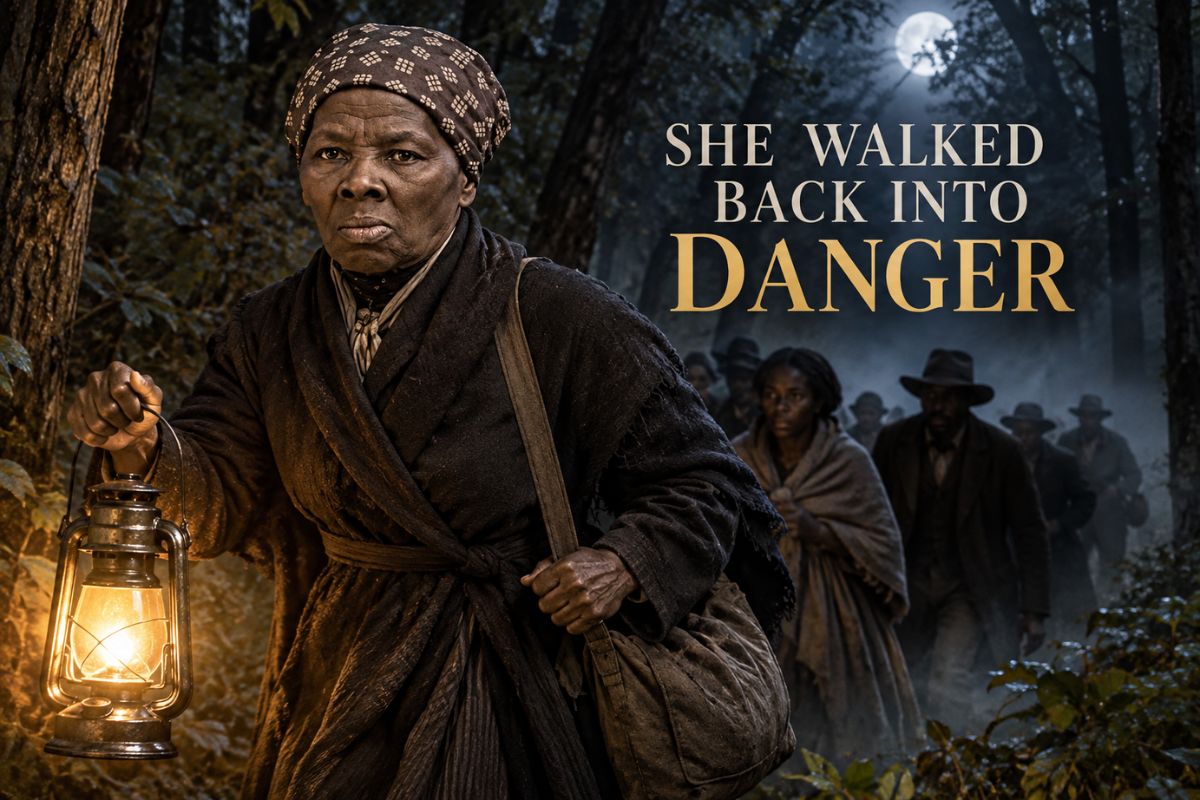
Harriet Tubman was born into a system designed to crush the human spirit, yet she spent her life dismantling it piece by piece. She was not a distant symbol or a figure polished by later legend. She was a woman of flesh and blood who walked back into danger again and again so that others might breathe free air. Her story is not merely one of escape. It is one of return, of relentless purpose, and of a quiet refusal to accept the limits placed on her body or her people.
She entered the world around 1822 in Dorchester County on Maryland’s Eastern Shore as Araminta Ross, called Minty by those who knew her. Her parents, Ben Ross and Harriet “Rit” Green, were enslaved. Ben worked the timber. Rit cooked and cared for the household of their enslavers. Nine children were born to them, and Minty was among the middle ones. From early childhood she was hired out to other households. At five or six she was already nursing white infants, later working the fields, cooking, and cutting wood. The violence of that world left permanent marks. Overseers whipped her for minor infractions. She carried the scars for life.
The most devastating injury came when she was about twelve or thirteen. An overseer threw a heavy iron weight at a young man who had left the fields without permission. Minty stepped into the path. The weight struck her skull. She nearly died. For the rest of her days she suffered crushing headaches, sudden seizures, and spells of deep sleep that overtook her without warning. The injury also deepened her faith. She began to experience vivid dreams and visions that she understood as messages from God. Those visions would later guide her through the darkest nights of the Underground Railroad.
Around 1844 she married John Tubman, a free Black man. She took her mother’s first name and her husband’s last, becoming Harriet Tubman. The marriage did not free her. She remained legally enslaved. When her enslaver died in 1849, rumors spread that she and others would be sold farther south to settle debts. Separation from family was a constant terror. Harriet decided she would not wait for that fate. In September 1849 she fled with two of her brothers. The brothers grew afraid and turned back. Harriet continued alone, traveling by night, following the North Star, relying on the quiet network of free Blacks and white allies who formed the earliest strands of the Underground Railroad. She reached Philadelphia and crossed into free territory.
The moment of freedom was complicated. “I had crossed the line,” she later said. “I was free; but there was no one to welcome me to the land of freedom. I was a stranger in a strange land.” She had left behind her parents, siblings, and the husband who would not come with her. Freedom without family felt incomplete. Within a year she was planning her first return.
In December 1850 she went back into Maryland and brought out her niece Kessiah Jolley along with Kessiah’s two children. That journey marked the beginning of roughly thirteen trips over the next decade. She rescued about seventy people, most of them family and close friends from the Eastern Shore communities she knew intimately. She also gave precise instructions to roughly another seventy who found their own way north. She never lost a single passenger under her direct guidance. That record was not luck. It was discipline, careful planning, and an iron will.
She traveled almost exclusively at night. She preferred the colder months when nights were longer and fewer people were outdoors. She carried a small pistol, not only for protection against slave catchers but to discourage anyone in her party from turning back in panic and endangering the whole group. She used disguises, coded spirituals, and the geography she had learned as a child working the land and the waterways. After the Fugitive Slave Act of 1850 made northern cities less safe, she pushed the routes farther into Canada, where slavery was outlawed. She brought her elderly parents out in 1857 and settled them on land she later purchased near Auburn, New York, from the abolitionist Senator William H. Seward.
People began calling her Moses. The name fit. She led her people out of bondage with a calm certainty that seemed almost biblical. Frederick Douglass, who knew the dangers of the work, later wrote that he had labored in the light while she worked in the shadows. Her labor required a different kind of courage. Every return raised the risk of capture, torture, or death. Rewards were posted for her. Still she went back.
When the Civil War began, Harriet Tubman did not stay safely in the North. In 1862 she traveled to the South Carolina coast, where Union forces held territory and thousands of formerly enslaved people had fled to their lines. She served first as a cook and nurse, using her knowledge of herbal remedies to treat the sick and wounded. Soon her skills as a scout and intelligence gatherer became clear. She moved behind Confederate lines, gathering information on troop movements and supply routes. She recruited and organized a small network of local scouts and pilots who knew the rivers and the rice plantations.
On the night of June 1 into June 2, 1863, she guided Colonel James Montgomery and several hundred Black soldiers of the 2nd South Carolina Infantry up the Combahee River. Three gunboats moved carefully through waters she and her scouts had helped clear of Confederate mines. At the plantations along the river they burned rice stores and other supplies that fed the Confederate army. More than seven hundred enslaved men, women, and children rushed to the boats when the steam whistles sounded. Many of the men immediately enlisted in the Union army. The raid was a military success and a massive liberation. Harriet Tubman became the first woman in United States history to lead an armed military expedition. Newspapers called her the “She-Moses” of the operation.
After the war she returned to Auburn. In 1869 she married Nelson Davis, a Civil War veteran more than twenty years her junior. They adopted a young girl named Gertie. Money was always scarce. The government was slow to grant her a pension for her wartime service, and she struggled financially for years. Yet she continued to open her home to anyone in need. She took in orphans, the elderly, and the sick. In time that practice grew into the Harriet Tubman Home for the Aged, a place of refuge on the property she had bought decades earlier.
She also turned her energy toward women’s suffrage. She spoke at meetings, stood with Susan B. Anthony and other advocates, and insisted that the fight for the vote belonged to Black women as fully as to anyone else. The same voice that had guided people through the woods now argued that citizenship without the ballot was incomplete. Her body, damaged by the old head injury, grew weaker with age. She underwent brain surgery in an attempt to ease the pain and the buzzing in her skull. In her final years she lived in the home she had helped create. On March 10, 1913, she died of pneumonia. She was buried with military honors at Fort Hill Cemetery in Auburn. Her last words, spoken to those gathered around her, were simple and steady: “I go to prepare a place for you.”
What makes Harriet Tubman endure is not the exaggeration that sometimes surrounds her story. Early biographies claimed she freed three hundred people on nineteen trips. Careful research shows the true numbers were smaller and more personal: about seventy guided by her own hand across thirteen journeys, plus those she instructed. The Combahee raid alone freed more than seven hundred. The difference matters because the real achievement is more impressive, not less. She did not free anonymous masses from distant states. She returned, over and over, to the specific fields and houses of her childhood, risking everything for people whose names and faces she knew.
Her methods were practical. She studied the land. She read the weather and the stars. She enforced order when fear threatened to break a group. She trusted her faith without becoming reckless. She understood that freedom required both daring and discipline. She also understood that liberation was not finished when the chains fell. It required land, community, care for the vulnerable, and a voice in the decisions that shape a nation.
In an age that still wrestles with questions of justice, belonging, and the unfinished work of equality, her example remains sharp. She showed that ordinary people, equipped with courage and clarity of purpose, can force history to change direction. She did not wait for perfect conditions. She moved in the dark, guided by the North Star and by an unshakable conviction that liberty was a right no one could permanently deny. She paid for that conviction with pain, poverty, and constant danger, yet she never stopped.
Harriet Tubman lived nearly ninety years. In that span she crossed from bondage into freedom, then turned around and led others across the same line. She served a nation that had once claimed her as property. She built a home for those the world discarded. She spoke for the rights of women who were still denied the ballot. Through it all she remained rooted in the simple, radical idea that every human being deserves to walk free under the open sky.
Her life asks a quiet but persistent question of anyone who encounters it. What will you risk for the freedom of others? How far will you go when the path is uncertain and the cost is high? Harriet Tubman answered those questions with her feet, her hands, and her unyielding will. The path she cleared still invites travelers. The example she set still lights the way.