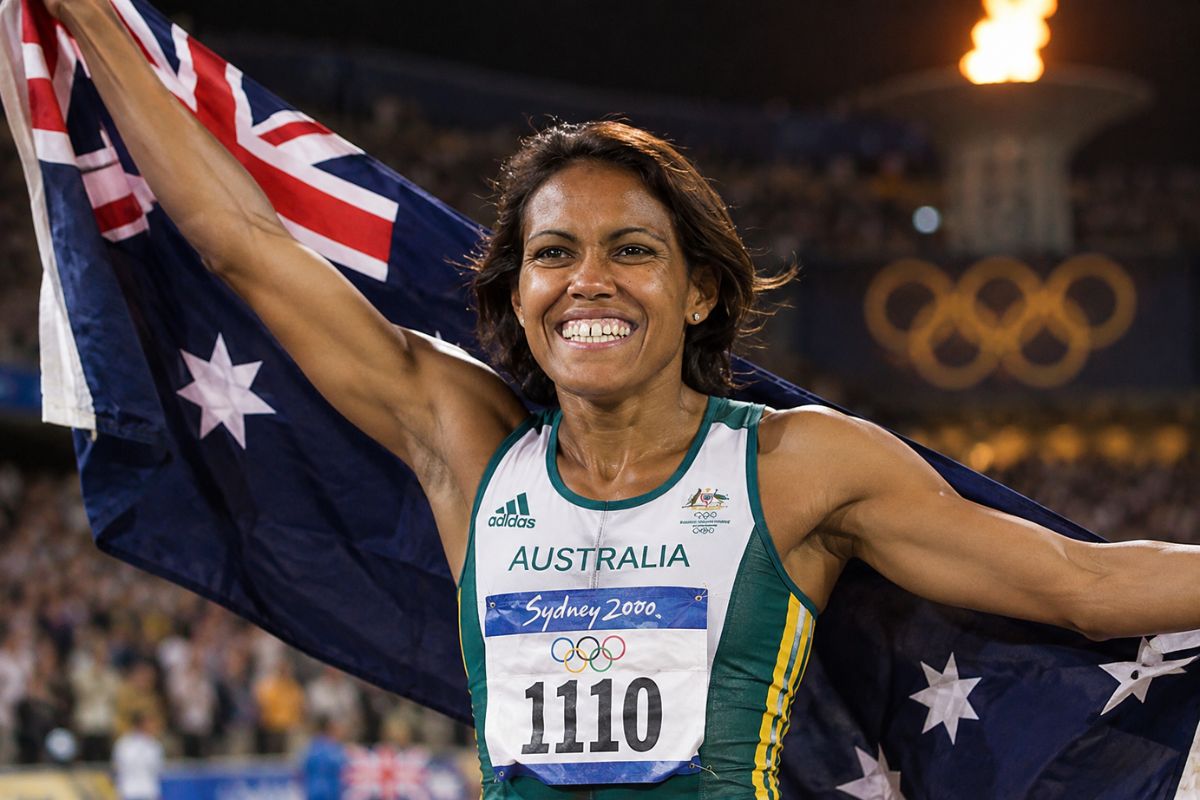
She stood alone in the centre of a stadium that held more than one hundred thousand people and carried the hopes of a nation on her shoulders. Cathy Freeman did not simply run a race in Sydney in September 2000. She completed a journey that began in the quiet towns of Queensland and ended under the bright lights of an Olympic final that the whole world watched. In that moment she became more than an athlete. She became a symbol of possibility for Indigenous Australians and for anyone who has ever been told their dreams are too big.
Catherine Astrid Salome Freeman was born on 16 February 1973 in Mackay, Queensland. Her mother, Cecelia, belonged to the Kuku Yalanji people. Her father, Norman, known as Twinkle Toes for his speed on the rugby league field, came from the Birri Gubba people. Cathy grew up proud of her Aboriginal heritage at a time when that pride often met resistance. She was a natural runner from childhood. At fourteen she told a career adviser that she wanted to win Olympic gold medals. When asked what she would do after that, she answered simply that she did not care. The goal itself was enough.
Her talent emerged early. At sixteen she became the first Indigenous Australian woman to win a Commonwealth Games gold medal, running in the 4×100 metres relay in Auckland in 1990. Four years later in Victoria, Canada, she claimed individual gold in both the 200 metres and the 400 metres. She draped both the Australian and Aboriginal flags around her shoulders on the victory lap, a quiet but powerful statement of identity that drew both praise and criticism. She refused to choose between the two. She belonged to both.
The 1996 Atlanta Olympics brought her first major individual Olympic medal, a silver in the 400 metres behind France’s Marie-José Pérec. The race was fierce. Freeman stayed with the favourite into the final stretch before Pérec pulled away to set an Olympic record. The silver confirmed what many already knew. Freeman belonged among the world’s best. She followed it with world championship gold in the 400 metres in 1997 and again in 1999. By the time the Sydney Games approached, expectation had grown into something almost unbearable.
Eleven days before her final, Freeman lit the Olympic cauldron at the opening ceremony. The honour was deliberate. Six Australian women who had won a combined fifteen Olympic gold medals carried the torch before her. When the flame rose, it was an Indigenous woman who set it alight. The image travelled across the globe. Ten days later she stepped onto the track for the 400 metres final wearing a full-body green and gold bodysuit. The stadium was packed. Millions more watched on television. She ran with calm precision and crossed the line in 49.11 seconds to take the gold. She dropped to her knees, then rose and completed another victory lap carrying both flags once more. The emotion was overwhelming because the achievement was larger than sport.
Freeman retired from competitive running in 2003. She could have stepped away into quiet private life. Instead she turned her attention to the communities that had shaped her. She established the Cathy Freeman Foundation to support the education and wellbeing of Indigenous children. The work continues to focus on practical opportunities rather than symbols alone. She has received the Order of Australia, been named Australian of the Year, and later elevated to Companion of the Order of Australia. Yet the medals and awards never defined her completely. What remained was the example of a woman who ran with purpose and then used her platform to open doors for others.
Her story carries a quiet force. She faced the weight of national expectation and the deeper weight of representing a people long pushed to the margins. She answered both with discipline, grace, and an unshakable sense of self. She showed that excellence and identity do not have to stand in opposition. They can strengthen each other. In a country still wrestling with its history, her gold medal and the flame she lit remain lasting images of progress made visible through human effort.
Cathy Freeman never claimed to solve the complex questions of reconciliation. She simply ran as fast and as true as she could, and in doing so she gave a nation a moment of shared pride that still resonates. That is the mark of a true champion. She left the track, but the path she cleared remains open for those who follow.