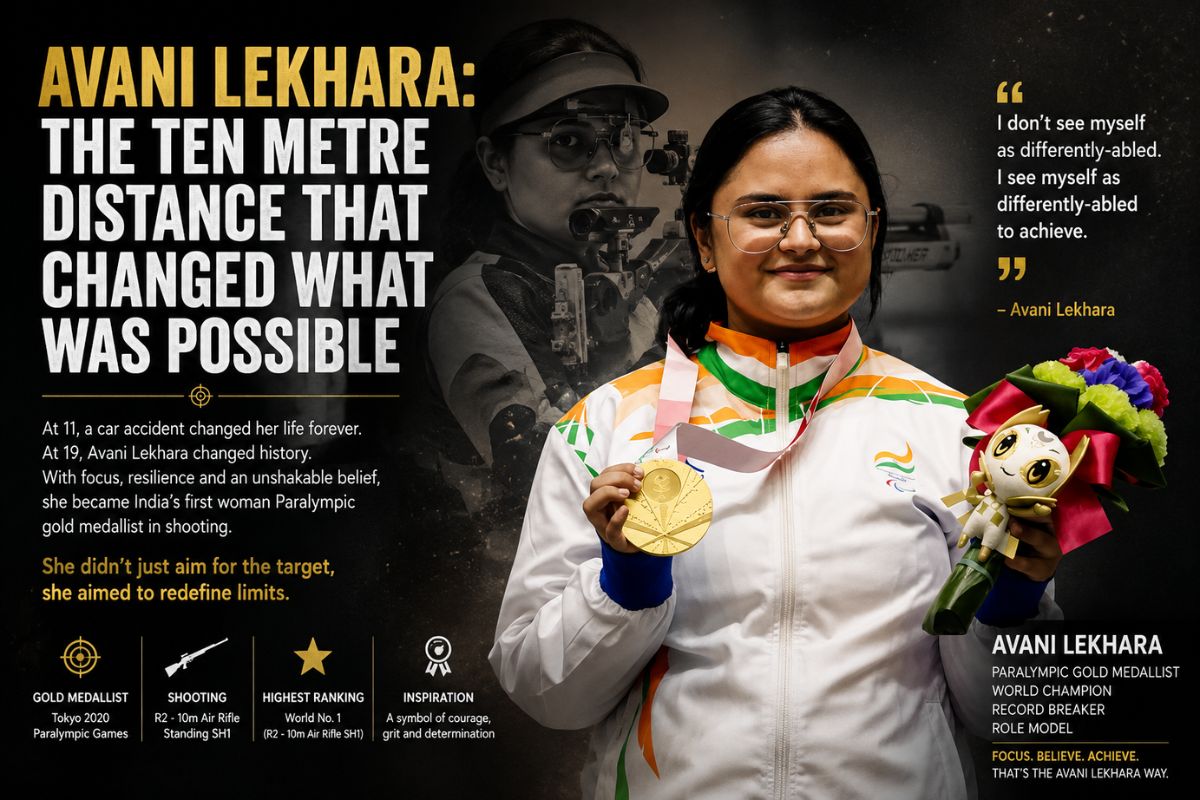
Ten metres separates a Paralympic air rifle shooter from her target, close enough that a single unsteady breath can cost a medal, far enough that the smallest error in posture, grip, or focus shows up instantly on the scoreboard. Avani Lekhara has spent the better part of a decade mastering that ten metre distance from a wheelchair, and in doing so became, in 2020, the first Indian woman ever to win a Paralympic gold medal. Four years later in Paris, she did it again, becoming the first Indian woman to win two consecutive Paralympic gold medals in the same event. The story behind those two golds starts, as so many stories like this do, with an ordinary car ride that stopped being ordinary in a single moment.
The Accident That Rewrote Everything
In 2012, at eleven years old, Lekhara was involved in a car accident that left her with a spinal cord injury and complete paraplegia. Before that day, by her own account, she was a different kind of kid entirely, drawn to dancing and singing rather than the disciplined stillness competitive shooting would eventually demand of her. The adjustment that followed was not simply physical. She has spoken candidly about having to relearn tasks as basic as sitting upright, describing the entire experience as starting over from point zero rather than adapting an existing life to new circumstances.
What followed the accident was less a straight line toward triumph than a genuinely difficult stretch of rehabilitation, during which her parents encouraged her to explore sport, first archery, and eventually shooting, partly as a therapeutic outlet and partly in search of something that could give her a renewed sense of control and precision over her own body. She has credited Abhinav Bindra’s autobiography, detailing his own path to India’s first individual Olympic gold in shooting, as a specific source of inspiration during this period, drawn less to the medal itself than to the mental discipline and precision the sport demanded, qualities that felt, to an eleven year old relearning how to sit up straight, like something worth chasing.
Building A Career Out Of Stillness
Formal training began around 2015, and Lekhara worked under coaches including Chandra Shekhar and later Suma Shirur, adapting standard shooting technique to accommodate her disability, a process that in competitive para shooting requires as much technical problem solving as physical training itself, wheelchair positioning, adapted equipment, and a stance rebuilt from the ground up rather than simply modified. She has spoken repeatedly and specifically about the mental dimension of the sport, estimating that shooting at the elite level runs somewhere between seventy and eighty percent mental rather than purely physical, a discipline she reinforces through yoga, structured breathing exercises, and dedicated mental training alongside the physical practice most people assume is the whole of an athlete’s preparation.
That mental framework carried her to the 2020 Tokyo Paralympics, delayed a year by the pandemic, where she won gold in the women’s 10m air rifle standing SH1 event, becoming the first Indian woman in history to win a Paralympic gold medal, and adding a bronze in a second event during the same Games, making her the first Indian to win multiple medals at a single Paralympic edition. Four years later at the Paris 2024 Paralympics, she defended that title, scoring 249.7 to set a new Paralympic record and becoming the first Indian woman to win two consecutive Paralympic gold medals in the same event, a level of sustained excellence that pushed her to the World No. 1 ranking in her classification.
What She Says The Losses Taught Her
What separates Lekhara’s public account of her career from a simple highlight reel is how openly she credits her setbacks rather than only her medals. She has said plainly that the lows in her career taught her considerably more than the highs ever did, that highs, in her own words, do not teach much, while the mistakes and failures along the way did the real work of shaping her as a competitor. It is a notably unsentimental way to describe a career built on top of a genuinely traumatic injury, and it reflects a broader theme in how she discusses her own story, treating the accident and its aftermath not as a tragedy she overcame once and for all, but as an ongoing discipline she continues to actively manage, mental training included, rather than a chapter that simply closed the day she won her first gold medal.
Advocacy Beyond The Podium
Lekhara has used her platform to push a message that extends well past her own competitive career. She has publicly identified as part of the disability community and has been direct about a gap that rarely gets discussed alongside Paralympic success stories, the sharp disparity between the accessibility built into elite competition venues and the accessibility, or lack of it, in everyday public infrastructure that people with disabilities actually have to navigate daily. It is a pointed observation, that a country can build a world class shooting range accessible enough for a Paralympic champion to train in, while the pavement outside a neighbourhood market remains impassable for a wheelchair user simply trying to run an errand. Her stated hope is that her own achievements motivate others to live without self-imposed limitations, a message she extends specifically to people navigating disability rather than framing purely as generic athletic inspiration. Alongside her competitive schedule, she has continued pursuing her academic studies, balancing training and competition with formal education in a way that keeps her public identity from narrowing down to shooting alone.
Part Of A Larger Shift
Lekhara’s rise sits inside a broader, welcome shift in how Indian sport treats disability and athletic excellence together rather than as separate categories. Real Shee Power’s own profile of Aboli Jarit, the wheelchair using model and singer who has reshaped how adaptive fashion and public visibility intersect in India, traces a parallel arc in an entirely different field, a woman refusing to let a physical condition define the outer limit of what a public career could look like. Both stories point toward the same underlying shift, disability increasingly treated in Indian public life as a fact about circumstance rather than a verdict on capability, a shift Lekhara’s own two Paralympic golds have done as much as any single achievement to accelerate.
What The Ten Metres Actually Represent
Strip away the medal count and what remains is a genuinely specific, well documented arc, an eleven year old relearning how to sit upright, a sport chosen partly for its demand of stillness and precision rather than speed, a decade of technical and mental training built from the ground up, and two gold medals earned four years apart against the best competitors in the world. Lekhara’s own account of that arc resists the easy, purely triumphant framing so often applied to Paralympic athletes, choosing instead to credit the failures as much as the golds, and to keep pointing, medal in hand, at the much larger and much less glamorous work still left to do on the accessibility of ordinary Indian streets. Ten metres separates her from a target on competition day. The distance she has actually covered runs considerably further than that.