
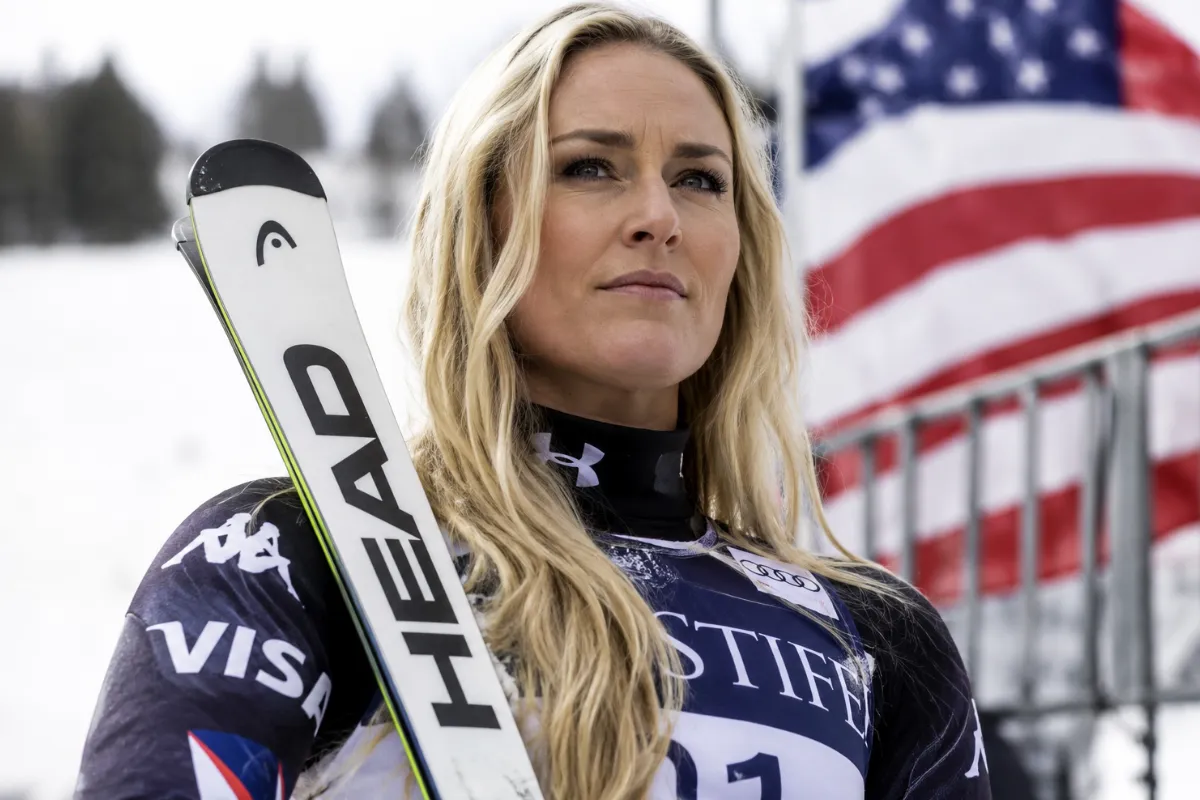
On a cold February morning in 2026 at the Milano Cortina Winter Olympics, the world watched Lindsey Vonn push out of the starting gate for the women’s downhill. At 41, she was living a story almost no one thought possible. Five years after retirement, multiple knee surgeries, and a torn ACL just nine days earlier, she was back on the biggest stage chasing one more Olympic medal.
Thirteen seconds later, everything changed.
She clipped a gate, lost control, and crashed hard. The images were brutal. Vonn was airlifted from the mountain with a complex fracture of her left tibia, a broken right ankle, and injuries severe enough that doctors later performed an emergency fasciotomy to save her leg from amputation. What followed were nine surgeries over the next nine months. Yet the woman who has defined resilience in alpine skiing has never been defined by a single fall.
This is the authentic story of Lindsey Vonn — one of the greatest alpine skiers in history and a powerful example of female strength, determination, and the refusal to quit.
From Minnesota Hills to World Dominance
Born on October 18, 1984, in St. Paul, Minnesota, Lindsey Vonn (née Kildow) grew up the oldest of five children. Her mother suffered a stroke during childbirth that left lasting effects, and the family dynamics were complicated. Skiing became both escape and identity. By age nine she was competing internationally. At 16 she stepped onto the FIS Alpine Ski World Cup circuit.
What followed was dominance. Vonn collected four overall World Cup titles (2008–2010 and 2012). She became the first woman to reach 82 World Cup victories (later adding more). She specialized in the high-speed disciplines — downhill and Super-G — where courage and precision meet at terrifying speeds. Her Olympic record includes gold in the downhill at the 2010 Vancouver Games plus two bronze medals. She earned eight World Championship medals and set multiple records for the most World Cup wins in downhill and Super-G.
Injuries were constant companions. She raced through pain for years. By 2019, after repeated knee problems, she retired. Many assumed the story had ended.
The Improbable Comeback
In 2024, after a partial knee replacement that finally quieted chronic pain, Vonn felt something shift. She announced her return to the U.S. Ski Team at age 40. Skeptics questioned whether a body that had already endured so much could compete at the elite level again.
She answered on the snow. In December 2025, at St. Moritz, the 41-year-old won a World Cup downhill — becoming the oldest athlete, male or female, to claim a World Cup victory. It was her first win since 2018 and her 83rd career World Cup triumph. She followed it with more strong results, proving the comeback was real. Heading into the 2026 Olympics she was a medal contender and the emotional centerpiece of the Games for many fans.
Then came the Crans-Montana crash in late January 2026. She ruptured the ACL in her left knee. Most athletes would have withdrawn. Vonn, cleared by her medical team and driven by the belief that she still had something left, chose to race the Olympic downhill on a compromised knee.
The Crash and the Fight to Keep Her Leg
The Olympic run lasted only seconds. The crash was catastrophic. Beyond the tibia fracture and ankle injury, compartment syndrome developed. Surgeons performed emergency procedures in Italy. Vonn later revealed that doctors saved her leg from amputation. Metal plates and dozens of screws stabilized the shattered bone. She underwent multiple operations in the immediate aftermath and more in the months that followed.
By November 2026 she faced her ninth surgery since the crash. At the Steadman Clinic in Vail, Colorado, surgeons spent more than five hours removing the plates and screws and reconstructing her ACL. Vonn shared photos of the hardware that had held her leg together and videos of early rehabilitation. She described the procedure as the one she hoped would be her last, knowing another six to nine months of recovery lay ahead while the bone holes healed and the new ligament strengthened.
Through it all she has remained characteristically direct and determined. She has spoken openly about the physical and emotional toll while refusing to close the door on skiing again — whether competitively or recreationally.
Why Lindsey Vonn’s Story Matters for Women Everywhere
Lindsey Vonn’s career is filled with records and medals. What resonates most deeply is the pattern of rising after every setback. She has modeled what it looks like to pursue excellence on her own terms, to challenge the assumption that elite athletic careers must end in a woman’s thirties, and to meet devastating injury with grit rather than resignation.
Her journey speaks directly to themes of resilience, mental toughness, and rewriting the narrative around women’s physical limits and longevity in sport. For a site like Real Shee Power focused on elevating women’s stories of strength, Vonn offers a living example of power that is both athletic and human — the kind that comes from choosing to keep going when the easier path is to stop.
As she continues rehabilitation in late 2026, the next chapter remains unwritten. What is already clear is that Lindsey Vonn’s legacy extends far beyond the podium. It lives in the example she sets for anyone facing their own mountain: the fall does not define you. How you rise does.
This is the story of a woman who has done amazing things — not once, but repeatedly — and who continues to show the world what unbreakable looks like.